Short answer: the right web development agency is the one that has built something close to your project, shows you real work and real references, writes down who owns the code and the hosting, and quotes a price that matches US market rates for the model you are buying. For most US businesses that means comparing three or four agencies on the same written brief, checking each one's past sites with free tools, and signing only when the contract covers accessibility, SEO and support after launch.
We run a web development agency ourselves, so we have sat on both sides of this decision: pitching for projects, and inheriting sites from agencies that did not work out. This guide covers what a web development agency actually does, how it differs from a web design agency, what US agencies charge in 2026, the questions that separate good teams from risky ones, and a sourced list of reputable US firms. Every figure links to the page we checked in October 2026.
What is a web development agency?
A web development agency is a company that plans, designs, builds and maintains websites and web applications for clients. Unlike a freelancer, it brings a team: usually a project manager, designers, front-end and back-end developers and a QA tester. Unlike an in-house team, you pay for the project or the hours rather than salaries, benefits and recruiting.
That difference in cost is bigger than most buyers expect. The US Bureau of Labor Statistics puts the median pay for web developers and digital designers at $99,520 a year (May 2025), before benefits or tools. A single hire also covers one skill set. A web development agency gives you design, engineering, testing and hosting knowledge for the length of the project and then lets you scale back to a support plan.
Web design agency vs web development agency: what is the difference?
The two terms get used interchangeably, but they describe different strengths. A web design agency starts from the brand and the visitor: layout, visual identity, user experience and copy. A web development agency starts from how the site works: code, integrations, databases, performance and security. Most good firms do both, but nearly every one leans one way, and you should know which before you sign.
| Web design agency | Web development agency | |
|---|---|---|
| Starts from | Brand, layout and user experience | Functionality, code and integrations |
| Core team | UI/UX designers, brand designers, copywriters | Front-end, back-end and full-stack developers, QA |
| Typical deliverables | Wireframes, design system, page designs, prototypes | A working site or app, APIs, CMS setup, hosting, documentation |
| Strongest for | Marketing sites, rebrands, portfolios | Online stores, portals, booking systems, web apps, integrations |
| Risk if it is the wrong fit | A beautiful design that is slow or hard to build | A solid build that looks generic or converts poorly |
| Ask them for | Before and after conversion data, Figma files | Live sites to test, code samples, uptime and speed data |
A web design company that outsources the build, or a development shop that buys templates for the design, can still do good work. Just ask who does each part, because the handoff is where most delays and budget overruns start.
What does a full-service web development agency actually do?
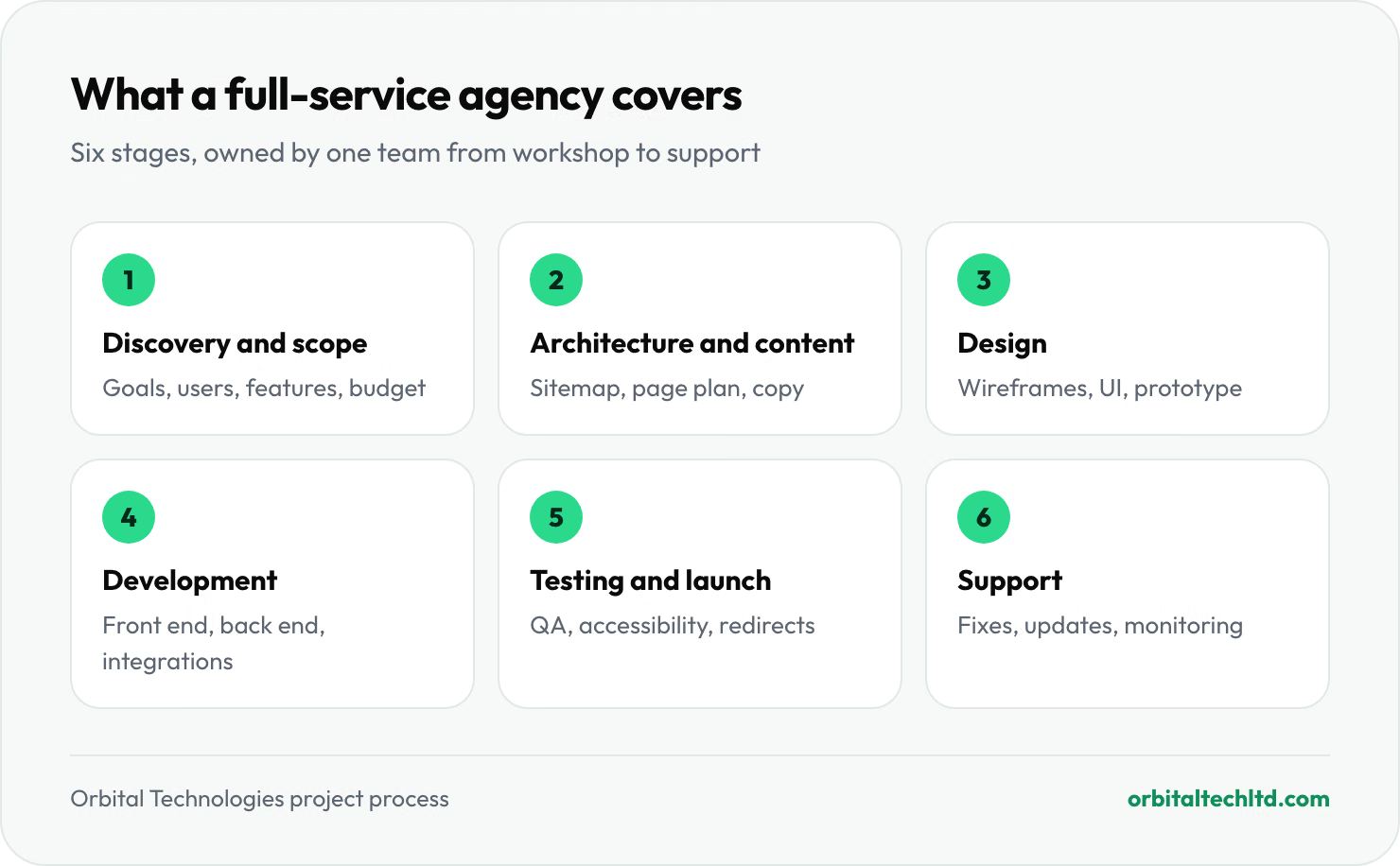
"Full-service" should mean one team owns the project from first workshop to the months after launch. In practice the work falls into six stages: discovery and scope, information architecture and content, design, development, testing and launch, and support. If a proposal skips any of these, ask who is doing it, because someone will have to.
Custom web development vs CMS platforms (WordPress, Shopify, Webflow)
The first technical decision a web development agency should help you make is whether to build on a content management system or write the site from scratch. It shapes cost, speed to launch and who can edit the site later.
| Option | Share of all websites | Best for | Watch out for |
|---|---|---|---|
| WordPress | 39.6% | Content-heavy sites, blogs, lead generation, sites a marketing team updates daily | Plugin bloat and hosting quality decide speed and security |
| Shopify | 5.3% | Online stores that want hosting, payments and checkout handled | Monthly fees, app costs and limits on checkout changes |
| Wix and Squarespace | 4.2% and 2.4% | Small sites a business owner runs alone | Limited control as the site grows; a Wix site cannot be exported |
| Webflow | 0.8% | Design-led marketing sites that need polish without plugins | Seat and hosting costs; complex logic needs custom code |
| Custom build (React, Next.js, Laravel and others) | Not tracked as one group | Web apps, portals, marketplaces, anything with real business logic | Higher upfront cost and you need a developer for most changes |
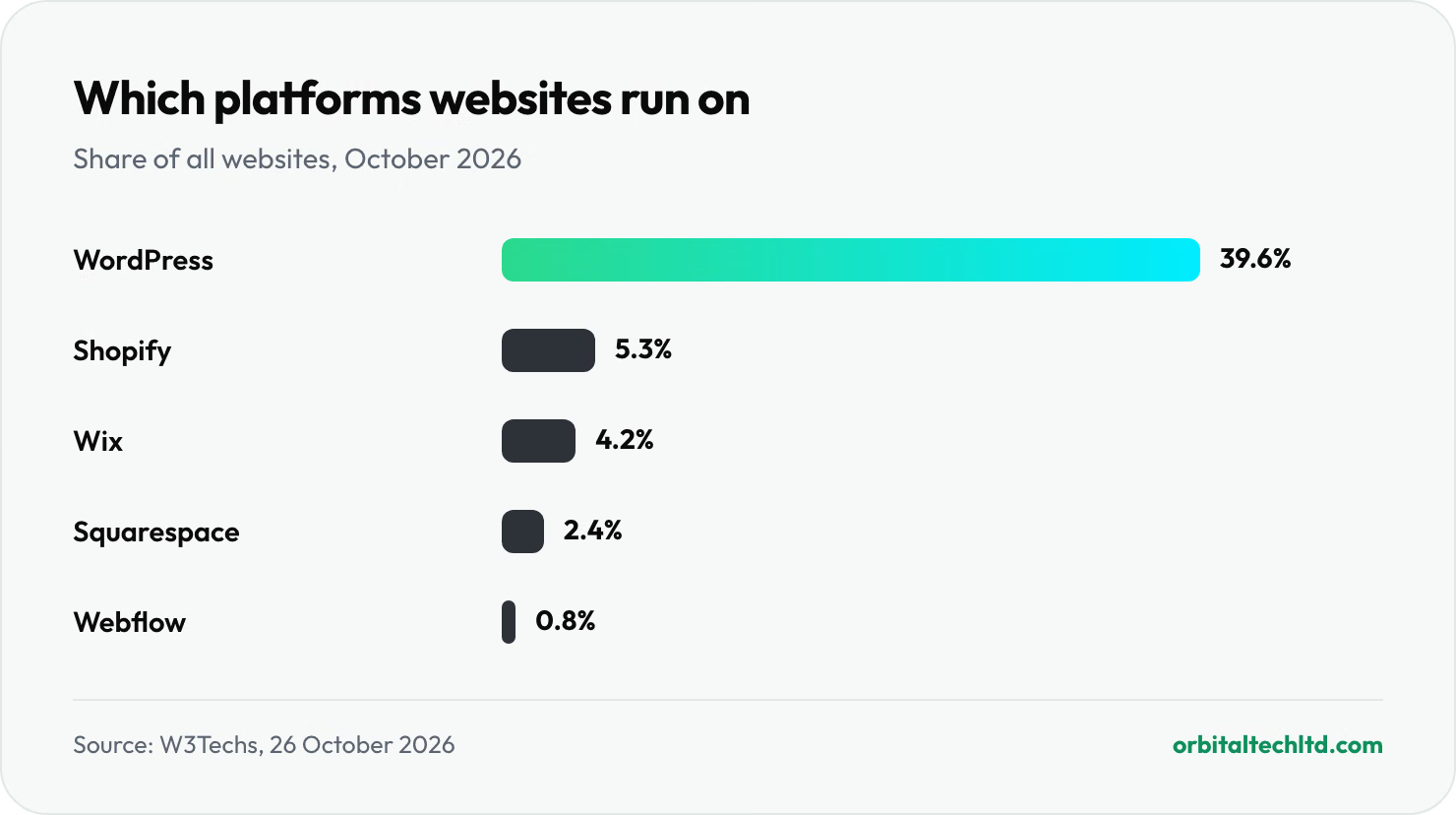
Shares are from W3Techs on 26 October 2026. A useful rule: if your site mainly publishes pages and sells products, a CMS is cheaper and faster. If users log in, make bookings, see their own data or trigger workflows, you are building software, and a custom build usually pays for itself. Our comparisons of Wix vs WordPress and Shopify vs WooCommerce go deeper on the platform choice.
Frontend, backend and full-stack engineering
Frontend engineers build what visitors see and touch: layout, navigation, forms and interactions, in HTML, CSS and JavaScript frameworks. Backend engineers build what runs on the server: databases, user accounts, payments, APIs and integrations with your CRM or ERP. Full-stack developers work across both, which suits smaller projects where one person can hold the whole picture.
Ask which frameworks the web development agency uses and why. According to the Stack Overflow Developer Survey 2025, Node.js (48.7%) and React (44.7%) are the most used web technologies among developers, with Next.js at 20.8% and Laravel at 8.9%. Popular is not automatically right, but a mainstream stack means you can hire another team later if you need to. Be cautious of a web development agency that builds on its own private framework, because you may be the only client who can never leave.
UI/UX design, accessibility (ADA compliance) and performance optimization
UI/UX design turns your goals into page structures and journeys a visitor can follow without thinking. Good agencies test designs with real users or at least with clickable prototypes before a line of code is written.
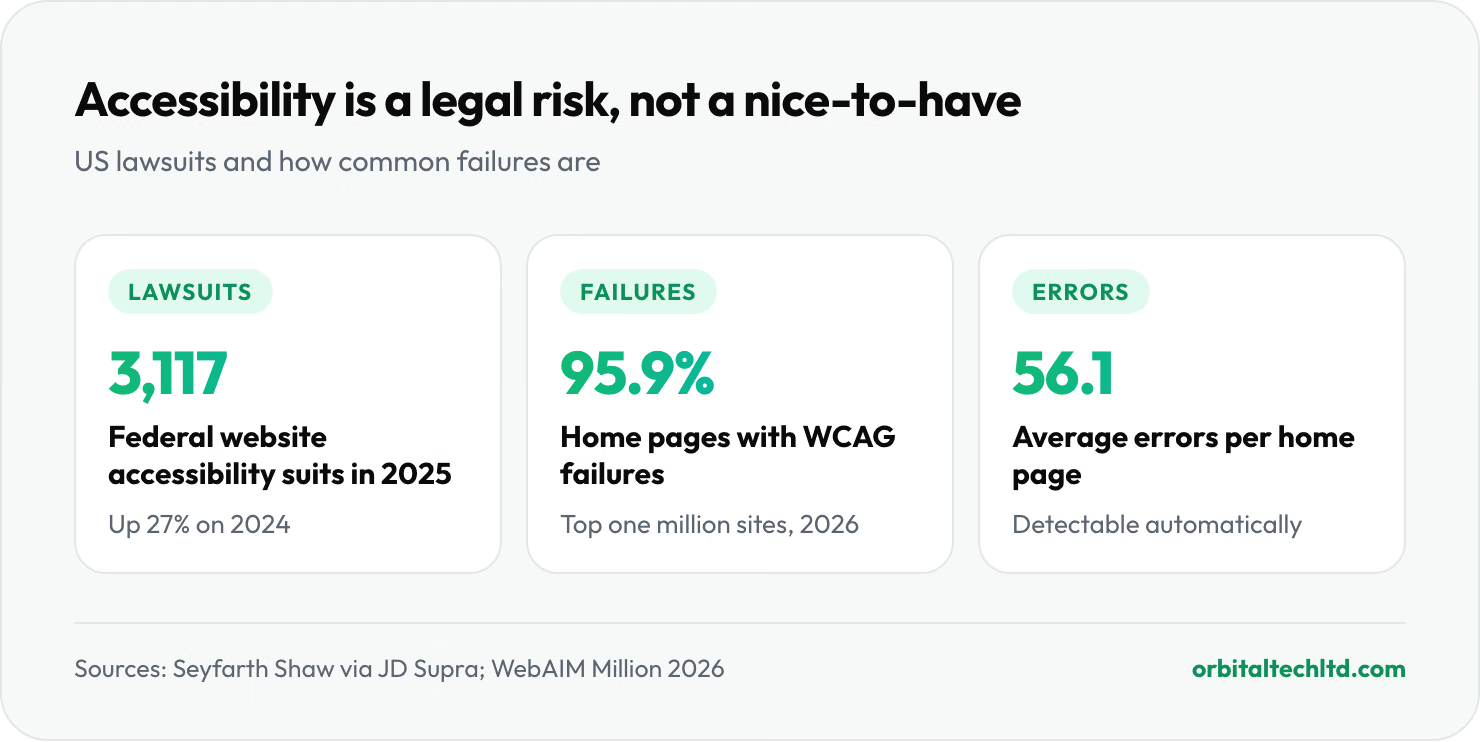
Accessibility is no longer optional for US businesses. Seyfarth Shaw counted 3,117 website accessibility lawsuits in federal court in 2025, up 27% on 2024, and that excludes state courts. Meanwhile the WebAIM Million 2026 found detectable WCAG failures on 95.9% of the top million home pages, with an average of 56.1 errors per page. Ask any web development agency to build to WCAG 2.1 Level AA, the standard the Department of Justice set for state and local government sites, and to show you an accessibility test report before launch. If you work with public bodies, note that DOJ extended the Title II deadlines in April 2026 to 26 April 2027 for larger governments and 26 April 2028 for smaller ones.
Performance means pages that load fast for real visitors and pass Google's Core Web Vitals. Ask for field data, not a lab score. Our guide to technical SEO explains the thresholds and the fixes.
When you might not need a web development agency
Not every project needs one. If you need a five-page site for a new business, have more time than money and are comfortable with a drag-and-drop builder, Wix or Squarespace will get you live for a few hundred dollars a year. If you already have a developer on staff and only need extra hands, staff augmentation may fit better than handing over a whole project. A web development agency earns its fee when the project needs several skills at once, when the site is central to how you sell, or when getting it wrong would cost more than the build. A web development company that tells you honestly when you do not need it is usually one worth calling back later.
The US web development agency market in 2026, by the numbers
These are the figures we would want in front of us before talking to any web development agency. Each one is linked to the page we checked.
| Measure | Figure | What it means for you | Source |
|---|---|---|---|
| Typical US agency hourly rate | $100 to $149 an hour | A US quote far below this is either offshore delivery or a junior team | Clutch, Sep 2026 |
| Most common rate worldwide | $25 to $49 an hour | Offshore and nearshore teams sit here | Clutch, Sep 2026 |
| Typical project on Clutch | Under $10,000; average $66,499 | A few large builds pull the average up; most projects are small | Clutch, Sep 2026 |
| Typical project timeline on Clutch | 9 months | Includes post-launch work; plan for more than the build itself | Clutch, Sep 2026 |
| Median pay for an in-house web developer | $99,520 a year | The baseline to compare an agency retainer against | US BLS, May 2025 data |
| Projected job growth for web developers | 5% from 2025 to 2035 | Good developers stay in demand; book agencies early | US BLS |
| Website accessibility lawsuits, federal courts | 3,117 in 2025, up 27% | Accessibility belongs in the contract, not the wish list | Seyfarth Shaw via JD Supra |
| Home pages with detectable WCAG failures | 95.9%, average 56.1 errors | Assume a new build will fail too unless someone tests it | WebAIM Million 2026 |
| WordPress share of all websites | 39.6% | The largest pool of agencies, plugins and developers | W3Techs, Oct 2026 |
| Mobile sites passing Core Web Vitals | Wix 81%, WordPress 48% | Build quality and hosting decide speed more than the platform name | HTTP Archive, Sep 2026 |
How much does a web development agency cost in the US?
A web development agency usually prices work in one of three ways. Fixed price suits a well-defined marketing site. Time and materials suits projects where requirements will change, such as a web app. Retainers suit ongoing work after launch. Whatever the model, a web development agency's hourly rate tells you a lot about who is doing the work.
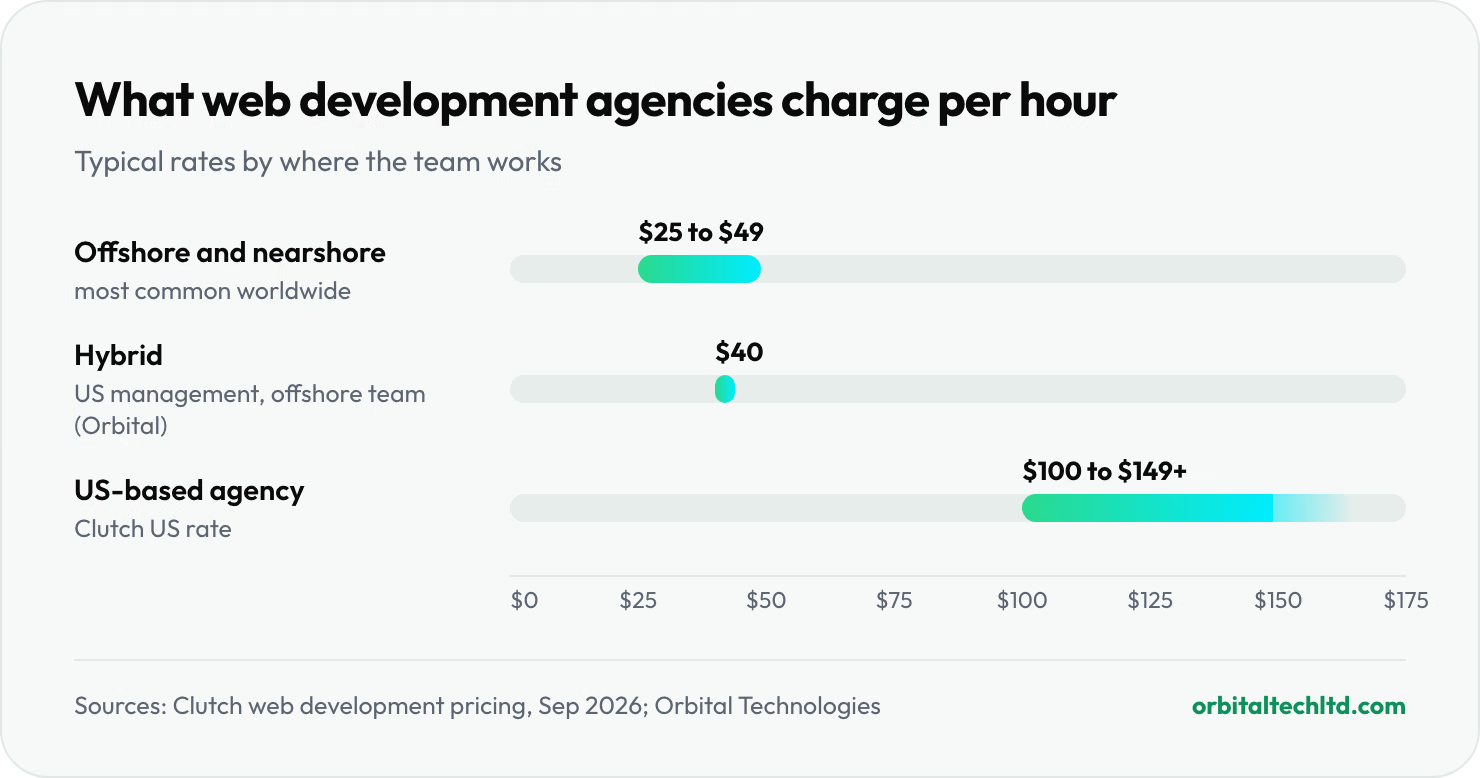
- A US-based web development agency will mostly charge $100 to $149 an hour on Clutch's figures, and boutique or enterprise firms go well above that.
- Offshore and nearshore teams cluster around $25 to $49 an hour.
- Hybrid agencies, with US management and an offshore delivery team, sit in between. We are one of these: Orbital Technologies is registered in the US with its head office in Jacksonville, Florida, and its developers in Pakistan, at $40 an hour.
For a sense of totals, a small business marketing site from an agency typically lands in the low thousands to low tens of thousands of dollars, a store or a site with integrations costs more, and custom web applications start in the tens of thousands. Our guides to how much a website costs and how much a web app costs break down the hours behind each price.
US-based, offshore or hybrid: which web development agency model fits?
| Model | Typical rate | Strengths | Trade-offs | Best when |
|---|---|---|---|---|
| US-based agency | $100 to $149+ an hour | Same time zone, in-person workshops, US contract law, deep local market knowledge | Highest cost; small budgets buy few hours | Regulated industries, enterprise projects, heavy stakeholder involvement |
| Offshore agency | $25 to $49 an hour | Most hours per dollar, large talent pools | Time zone gaps, contracts under foreign law, quality varies widely | Well-specified builds with an experienced in-house product owner |
| Hybrid (US management, offshore delivery) | In between | US contract and point of contact, lower build cost, overnight progress | You depend on the quality of the handoff between the two teams | Small and mid-sized businesses that want US accountability on a tighter budget |
None of these is right for everyone. What matters is that the web development agency is upfront about where the work happens. If a proposal is signed by a US office but the developers are elsewhere, that is fine, as long as you know it and the contract says which law applies. Our page on offshore software development explains how that model works in practice.
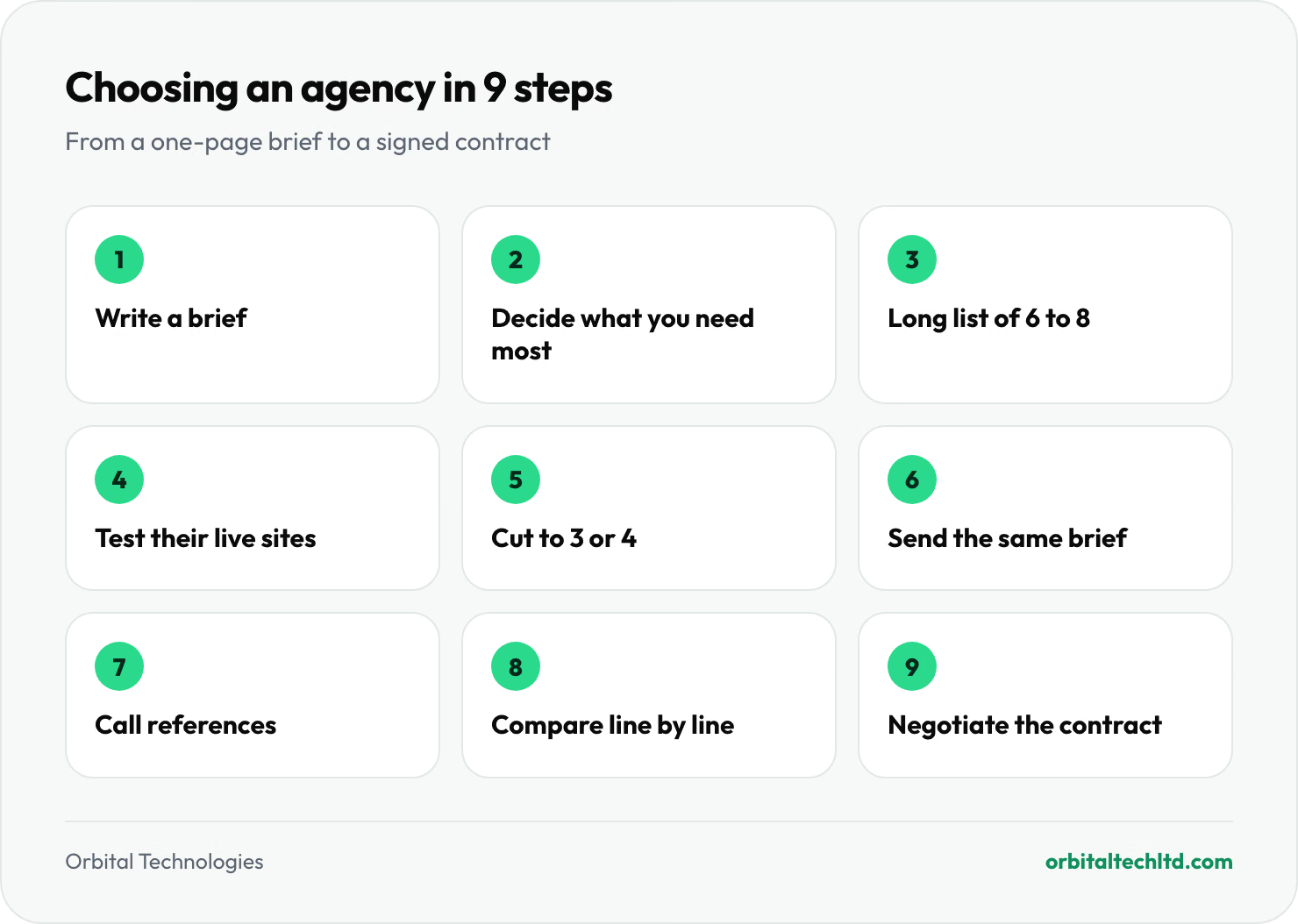
How to choose the right web development agency: 9 steps
- Write a one-page brief. Goals, audience, must-have features, integrations, budget range and deadline. A web development agency quotes against what you write, so a vague brief produces quotes you cannot compare.
- Decide what you need most. Design, development, content, SEO or ongoing marketing. Pick a web development agency whose strength matches the hardest part of your project.
- Build a long list of six to eight. Ask peers who they would hire again, look up who built sites you admire (the footer often says), and filter directories such as Clutch by location, budget and service.
- Check their live work yourself. Run three of their recent client sites through PageSpeed Insights and the WAVE accessibility checker. Ten minutes tells you more than any case study.
- Hold short calls and cut to three or four. Notice who asks about your business before talking about themselves.
- Send the same brief to the shortlist. Ask for a scope, a timeline, a fixed price or estimate range, and the names and roles of the people who will do the work.
- Call two references each. Ask what went wrong and how the agency handled it. Every project has a problem; you want the one that was solved well.
- Compare proposals line by line. Check what is excluded: content, stock photos, plugin licences, hosting, accessibility testing, SEO migration and training often are.
- Negotiate the contract, not just the price. Code and design ownership, access to hosting and domain accounts, a warranty period for bugs, and how change requests are priced.
12 questions to ask a web development agency before you sign
- Who exactly will work on our project, and are they employees or subcontractors?
- Can we see two live sites similar to ours, and speak to those clients?
- Which platform or framework do you recommend for us, and what would make you recommend something else?
- Who will own the code, the designs and the content when the project ends?
- Will the domain, hosting and analytics accounts be in our name?
- How do you test for accessibility, and which standard do you build to?
- What Core Web Vitals do your recent sites pass in the field?
- If we are replacing a site, how will you protect our search rankings during the move?
- How do you handle changes to scope, and what does a change cost?
- How often will we see progress, and through which tool?
- What does support look like after launch, and what are your response times?
- If we part ways, what do we receive and how long does the handover take?
Web development agency red flags that should end the conversation
- A price before any questions. A quote sent within an hour of your first email is a template, not an estimate.
- Hosting or the domain in the agency's name. It turns a supplier into a landlord.
- No live sites to show, only mockups or screenshots.
- Guaranteed rankings or "page one in 30 days". No honest agency can promise what Google decides.
- A private or proprietary CMS that only they can maintain.
- No mention of accessibility or redirects in a proposal for a site rebuild.
- Pressure to sign this week with a discount that expires.
How your web development agency affects SEO
The web development agency you choose decides most of your technical SEO for years, because it chooses the platform, the hosting, the URL structure and how pages render. It also decides whether a redesign keeps or loses your existing traffic.
The biggest risk is a site rebuild. When URLs change and nobody maps the old ones to the new ones with 301 redirects, the rankings those pages earned disappear with them. A good web development agency crawls your current site before the build, keeps a redirect map, and checks Search Console after launch. Ask to see that process in writing.
Build quality matters as much as platform. In the HTTP Archive data above, 81% of Wix sites pass Core Web Vitals on mobile against 48% of WordPress sites, yet a well-built WordPress site on good hosting passes easily. The platform is a starting point; the web development agency's choices about themes, plugins, images and hosting decide where you land.
Keyword research and gap analysis: what a good agency does before design
Pages should exist because people search for them. Before anyone designs the navigation, a good web development agency (or your SEO partner) should run keyword research in Google Search Console, Ahrefs or Semrush, then a keyword gap analysis that compares your domain with two or three competitors and lists the searches that send them traffic but not you. The benefit is a sitemap built on proven demand. Use Search Console when you already have a site with data; use a gap report when you are planning new sections or entering a market. Our SEO services start with exactly this step.
Reputable web development agencies in the USA, by project type
People often ask us for names. Below are well-known US-founded agencies, grouped by the kind of work they are known for. This is not a ranking, nobody paid to be listed, and we checked each fact on the agency's own site or a reputable release in October 2026. Ownership changes often in this industry, so check before you rely on it.
| Agency | Based | Founded | Ownership in 2026 | Known for |
|---|---|---|---|---|
| Huge | Brooklyn, NY | 1999 | Bought from IPG by AEA Investors in December 2024 | Enterprise digital experiences for brands such as Google and Nike |
| Work & Co | New York, NY | 2013 | Part of Accenture Song since January 2024 | Digital products, apps and commerce platforms for large brands |
| Instrument | Portland, OR | Early 2000s | Owned by Stagwell since 2022 | Design-led brand and digital work for Nike, Google and Salesforce |
| Big Human | New York area, with other US offices | 2010 | Not stated | Product design and development; incubated HQ Trivia and Vine |
| Clay | San Francisco, CA | About 16 years in business | Not stated | UX, branding and high-end websites |
| DockYard | Fully remote, US | 2010 | Not stated | Complex web apps built with Elixir and Phoenix |
| Fueled | US | 2007 | Merged with 10up in 2023, backed by Insignia Capital | Apps and digital products |
| 10up | US | 2011 | Fueled's enterprise WordPress practice | Large WordPress builds for clients such as Microsoft and Disney |
| WebFX | Harrisburg, PA | 1995 | Not stated | Websites tied to digital marketing and lead generation |
| Lounge Lizard | New York, NY | 1998 | Woman and family-owned | Web design and branding; clients include Canon and NYU |
Most of these firms are built for large budgets. If you are a small or mid-sized business, a smaller US or hybrid web development agency will usually give you senior attention for the same money that buys a few weeks of a big name. Use the list to understand the market, then apply the nine steps above to whoever fits your budget.
What about "top 10 web design agencies in the USA" lists?
Treat them with care. Many are published by agencies that place themselves first, and directory rankings are often influenced by paid placement and by how many reviews a firm has collected, not only by quality. They are useful for building a long list. They are not a substitute for checking live work and calling references.
How we work, so you can compare
For transparency, here is how our own team answers the questions above. Orbital Technologies has worked with 412 brands since 2018. Our marketing sites start from $2,500, you own the code and the accounts, and every build targets a Lighthouse score of 95 or more. For Digestive Care, a gastroenterology practice that had served Arkansas patients for over three decades with no real presence online, we built a site that explains every procedure in plain language and now run its SEO and digital marketing. You can see that and our other projects on our work page, and what is included in a build on our web development services page. Hold us to the same 12 questions as everyone else.
3 tips for hiring a web development agency, from our side of the table
- Pay for a short discovery phase first. A paid workshop of one or two weeks that ends in a written scope, sitemap and estimate lets you test the working relationship before committing the whole budget, and the document is yours to take elsewhere.
- Ask for the people, not the portfolio. The award-winning project in the pitch deck may have been built by people who have since left. Ask which team members worked on the examples you liked and whether they will work on yours.
- Put launch criteria in the contract. Define "done" as measurable checks: pages pass Core Web Vitals in the lab, the accessibility scan shows no critical errors, every old URL redirects, and forms deliver to the right inbox. It saves arguments at the end.
Our verdict
Choosing a web development agency is less about finding the best agency in the US and more about finding the right one for your project, budget and team. Decide what you need most, compare three or four agencies on the same brief, test their live sites yourself, and sign a contract that settles ownership, accessibility, SEO and support. Do that and most of the horror stories simply cannot happen to you.
If you would like a quote to compare against others, our web development team will answer every question on this page in writing. For WordPress or Shopify specifically, see our WordPress development and Shopify development pages, and for web apps, our custom software development service.