Short answer: AI search optimization is the work of getting your business found, cited and recommended inside AI answers: Google's AI Overviews and AI Mode, ChatGPT, Perplexity, Gemini and Copilot. These tools pull their answers from pages they can crawl, understand and trust, so the job comes down to five things: let the right crawlers in, rank in normal search, write passages that answer questions directly, make it obvious who you are, and get mentioned on sites people already trust.
There is no secret file or special markup. Google's own guide for site owners, updated in July 2026, says you do not need "new machine readable files, AI text files, markup, or Markdown" to appear in its AI features. What has changed is the scale. ChatGPT reached 900 million weekly users in February 2026, Google's AI Mode passed 1 billion monthly users by July, and the top organic result now gets 58% fewer clicks when an AI Overview sits above it.
What is AI search optimization?
AI search optimization means shaping your website and your wider reputation so that AI search tools choose your pages as sources and name your business in their answers. Traditional SEO aims for a ranked blue link. Here the aim is a citation inside a written answer, a mention of your brand when someone asks "who should I hire for this?", or a link in the sources panel beside the reply.
It is not a separate discipline that replaces SEO. AI tools still search the web before they answer. Google's AI Overviews draw on Google's index, ChatGPT search combines OpenAI's own crawler with outside search providers, and Perplexity runs its own crawler and index. A page that cannot be crawled, indexed or understood will not be cited by any of them. Think of it as SEO with three extra concerns: how your passages read when lifted out of the page, how clearly machines can identify your business, and what other sites say about you.
What is AI search optimization called? GEO, AEO, LLMO and AI SEO
The industry has not settled on a name, which is why you see several acronyms for broadly the same work. In a September 2026 survey of 160 marketers by the agency Koozai, "AI search optimisation" was the most preferred term at 32%, followed by generative engine optimization (GEO) at 19% and AI SEO at 18%.
| Term | What it usually means | Where you hear it |
|---|---|---|
| AI search optimization | The umbrella term: visibility in AI Overviews, AI Mode, ChatGPT, Perplexity and other assistants | Clients, managers, most agencies |
| Generative engine optimization (GEO) | Optimizing content to be used and cited by generative AI answers. The name comes from a 2023 research paper led by Princeton researchers | Researchers, SEO specialists |
| Answer engine optimization (AEO) | Getting your content chosen as the direct answer, originally for featured snippets and voice assistants, now for AI answers too | Content and SEO teams |
| LLM SEO or LLMO | Influencing how large language models describe your brand, including in chat tools that do not search the web for every answer | Technical SEOs, startups |
| AI SEO | Used two ways: optimizing for AI search, or using AI tools to do SEO work faster | Software vendors, job titles |
The labels matter less than the work. Whichever term your team uses, the tactics below are the same, and they sit on top of an SEO program rather than beside it.
AI search optimization by the numbers
Most guides on this topic argue from opinion. These are the figures that matter in 2026, each linked to the study or announcement it comes from.
| Measure | Figure | Source |
|---|---|---|
| ChatGPT weekly active users | 900 million (February 2026) | TechCrunch, 2026 |
| Google AI Mode monthly active users | Over 1 billion; the Gemini app has 950 million | Alphabet Q2 2026 remarks |
| Click-through rate of the top organic result when an AI Overview shows | 58% lower (300,000 keywords, December 2025 data) | Ahrefs, 2026 |
| US Google searches ending without a click | 68%, January to April 2026 | SparkToro via Search Engine Land |
| Visits where people clicked a normal result | 8% with an AI summary on the page, 15% without; 1% clicked a link inside the summary | Pew Research Center, 2025 |
| Pages cited in AI Overviews that also rank in the top 10 | 38% (March 2026), down from 76% in July 2025 | Ahrefs, 4 million citations |
| Strongest factor linked to brand mentions in AI Overviews | Branded web mentions (correlation 0.664) against backlinks (0.218) | Ahrefs, 75,000 brands |
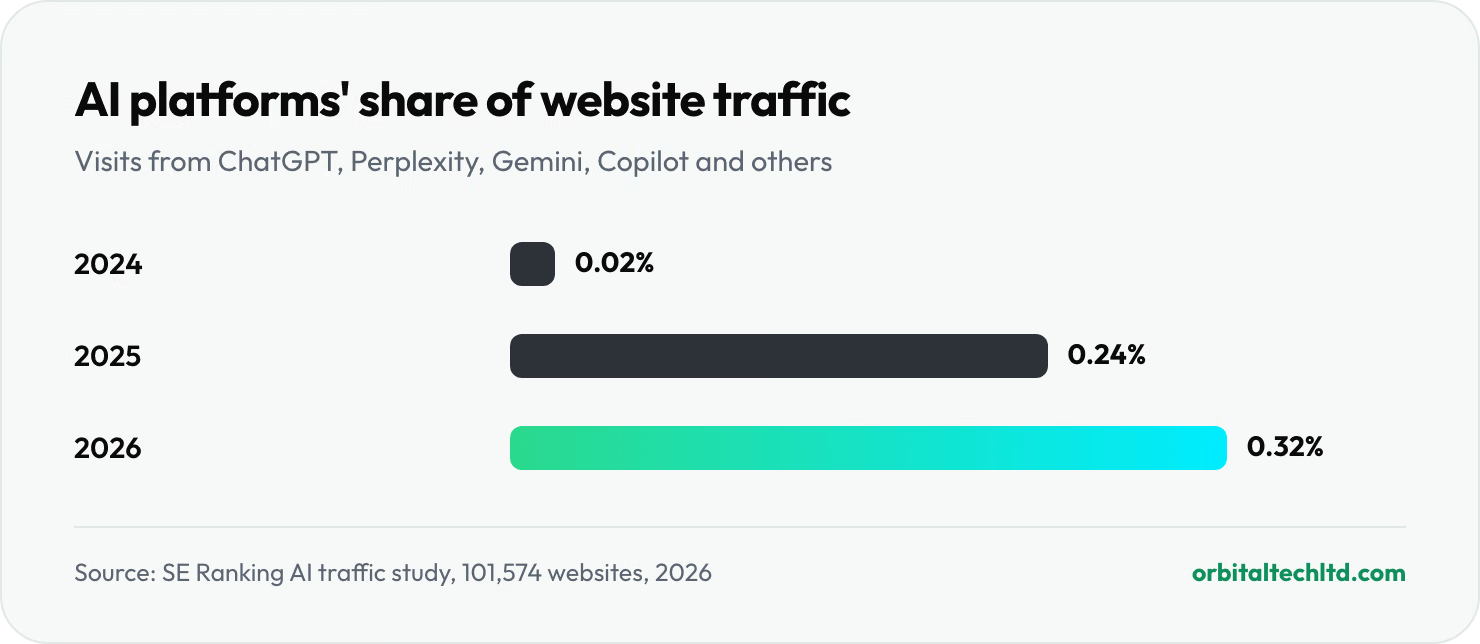
| AI platforms' share of all website traffic | 0.32% in 2026, up from 0.02% in 2024; ChatGPT sends 74.78% of it | SE Ranking, 101,574 sites |
| AI search visitors at one software company | 0.5% of visitors but 12.1% of sign-ups | Ahrefs, 2026 |
| Visibility gain from the best GEO methods in testing | Up to 40%; keyword stuffing made results about 9% worse | Aggarwal et al., KDD 2024 |
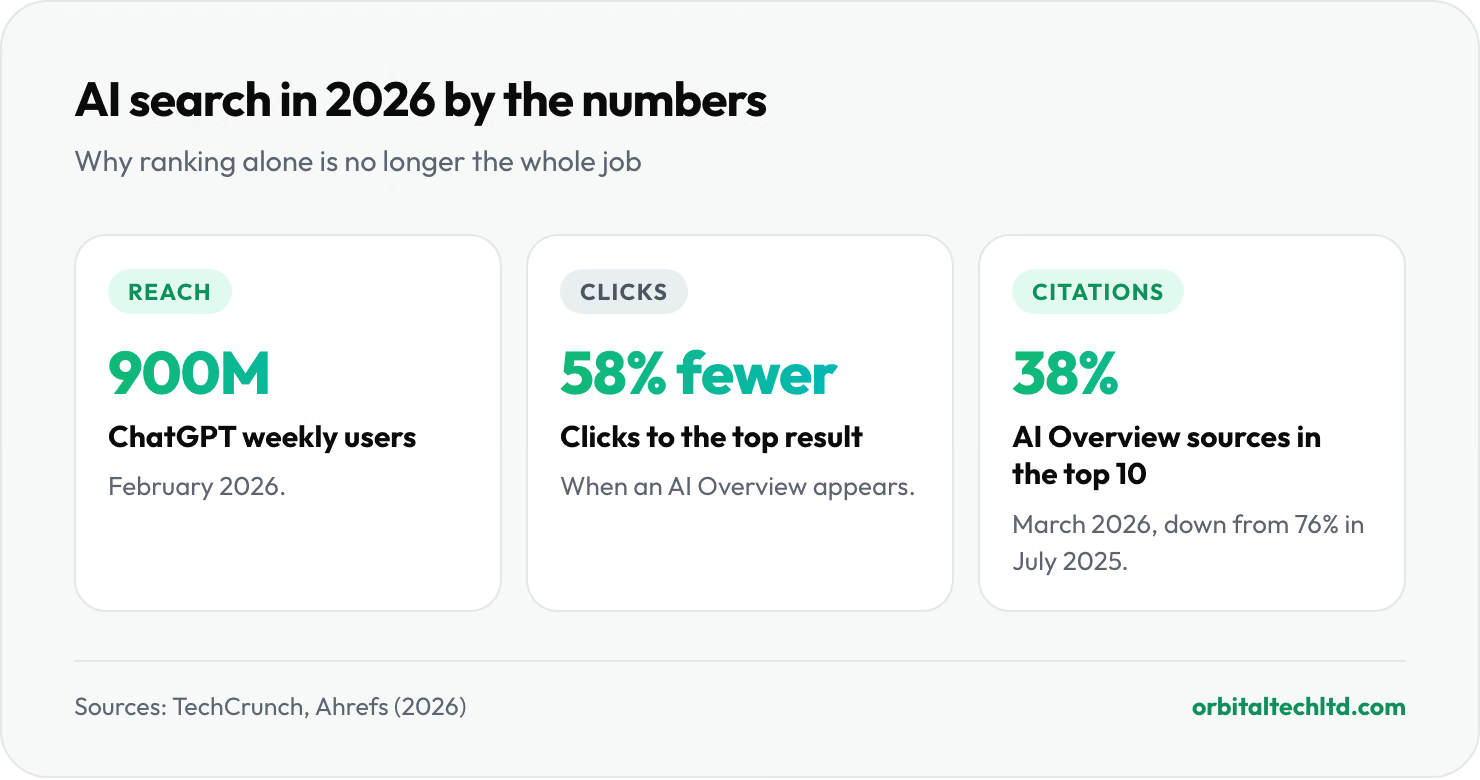
Read together, the numbers say two things. AI answers now sit between your customer and your website for a large share of searches, so fewer people click. And the pages those answers cite are no longer simply the top ten results, so ranking well is necessary but no longer enough. The traffic AI tools send is still small, under half a percent of visits on average, but it tends to arrive further along the buying journey.
How does AI search engine optimization work?
Each tool works differently, but the pattern is similar. When someone asks a question, the AI turns it into several related searches (Google calls this "query fan-out"), retrieves pages from an index, picks the passages that best answer each part, writes a summary, and links some of the sources it used. Two things follow from that process:
- If a page is not in the index, it cannot be cited. Crawl access, indexing and page speed matter as much as they ever did.
- Passages are judged, not just pages. Because the AI runs several searches per question, a page can be cited for one clear paragraph that answers one part of the question, even if it does not rank for the main query. That is one reason the overlap with the top ten has fallen.
The main AI search tools, and what each one relies on:
| Tool | Where its sources come from | Crawler to allow | How to measure it |
|---|---|---|---|
| Google AI Overviews and AI Mode | Google's search index | Googlebot | Search Console's generative AI performance report |
| ChatGPT search | OpenAI's crawler plus search partners | OAI-SearchBot | Referrals from chatgpt.com in your analytics |
| Perplexity | Perplexity's own index | PerplexityBot | Referrals from perplexity.ai |
| Microsoft Copilot and Bing | Bing's index | Bingbot | Bing Webmaster Tools AI Performance report |
AI search optimization vs traditional SEO
Most of the groundwork is shared. What changes is the unit of success, the signals that carry extra weight, and how you measure the result.
| Traditional SEO | AI search | |
|---|---|---|
| Goal | A high ranking and a click | A citation or a brand mention inside the answer |
| Unit that wins | The page | The passage, plus the brand behind it |
| Queries | Short keywords, often 2 to 4 words | Long, conversational questions split into many sub-searches |
| Trust signals | Links, relevance, page experience | The same, plus mentions of your brand across the web |
| Rendering | Google renders JavaScript | Most AI crawlers read the raw HTML only |
| Measurement | Rankings, clicks, conversions | Impressions in AI features, citations, referrals, share of answers |
That is why SEO for AI search belongs inside one SEO plan: the pages that earn rankings are the ones that earn citations.
How to rank in ChatGPT, AI Overviews and Perplexity: 8 steps
These steps run in order. Skipping the first two is the most common reason good content never appears in AI answers.
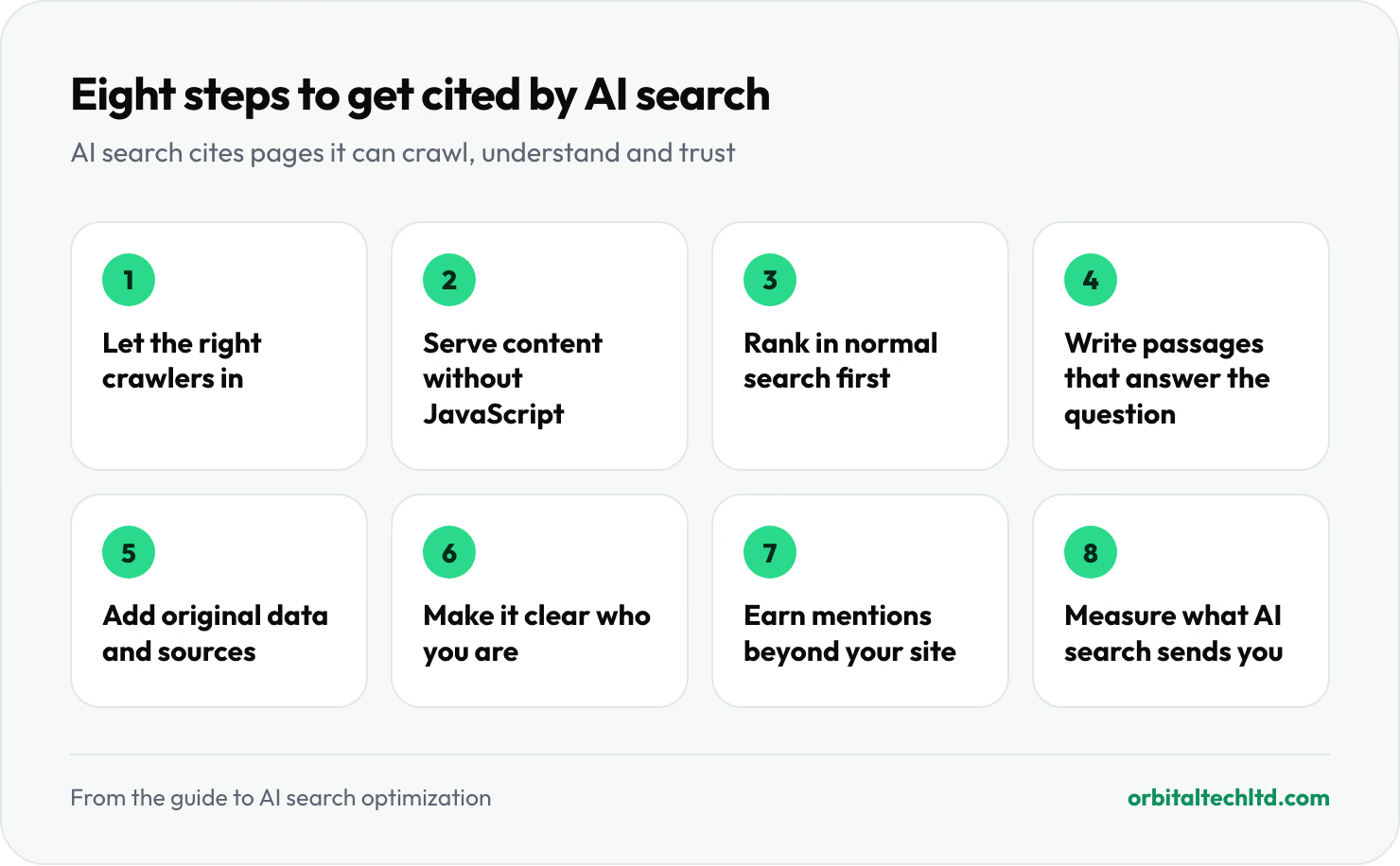
Step 1: Let the right crawlers in
Each AI company runs its own crawlers, and robots.txt controls them separately. Several companies run one crawler for search and another for model training, so you can appear in AI answers without letting your content be used for training.
| Crawler | Company | What it does |
|---|---|---|
| Googlebot | Normal Google Search crawling. AI Overviews and AI Mode use the same index, so blocking Googlebot removes you from all three. | |
| Google-Extended | Controls use of your content for training and grounding in some other Google AI products. It is not the control for AI Overviews. | |
| OAI-SearchBot | OpenAI | Surfaces sites in ChatGPT search. OpenAI says sites that opt out will not be shown in ChatGPT search answers, and robots.txt changes take about 24 hours to apply. |
| GPTBot | OpenAI | Collects content that may be used to train OpenAI's models. Blocking it does not affect ChatGPT search. |
| ChatGPT-User and Perplexity-User | OpenAI, Perplexity | Fetch a page when a user asks for it. Both companies say robots.txt rules may not apply, because a person started the request. |
| PerplexityBot | Perplexity | Surfaces and links sites in Perplexity's answers. Perplexity says it is not used to train AI foundation models. |
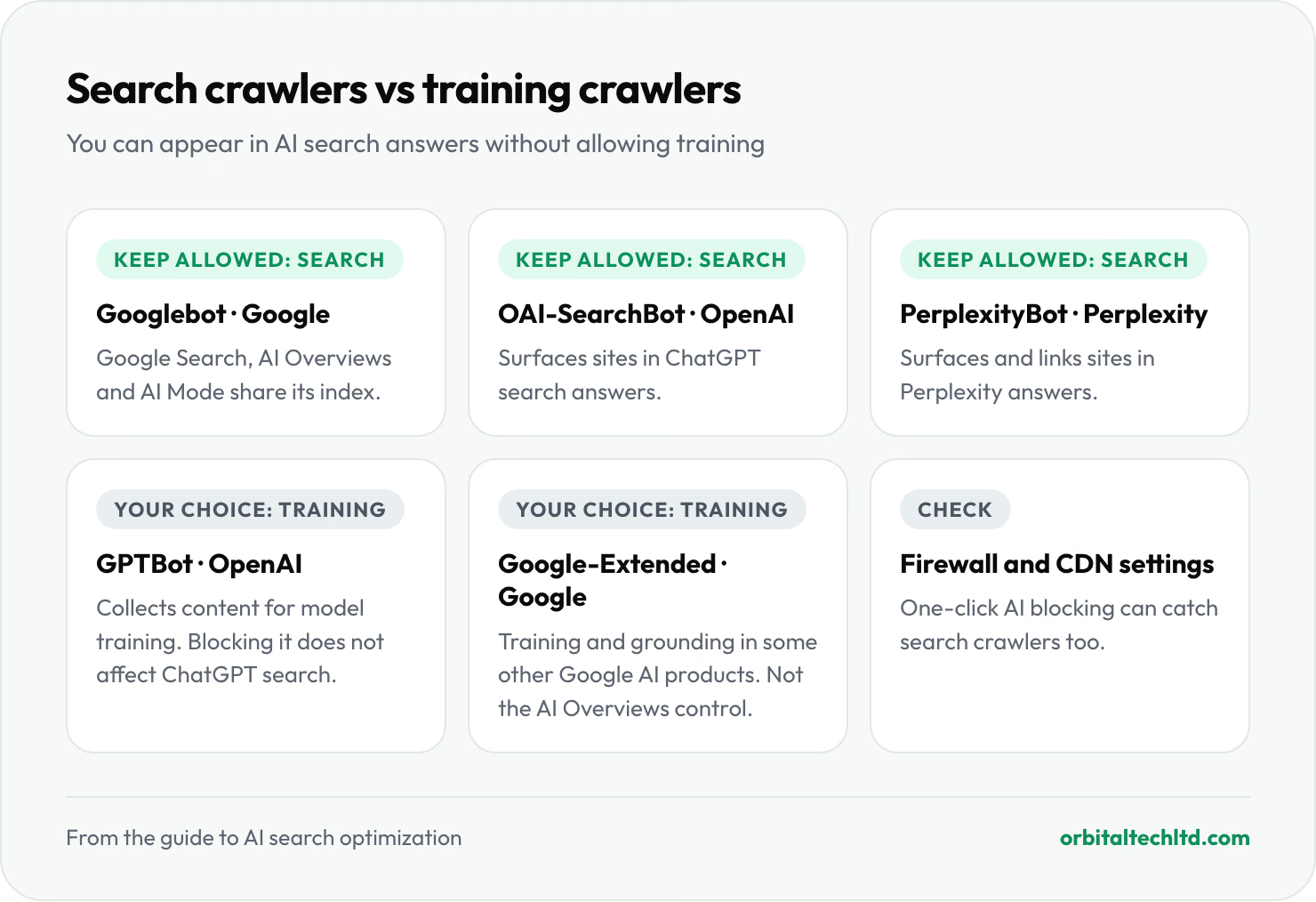
Then check the layers above robots.txt. In July 2025 Cloudflare changed its default to block AI crawlers on new sites unless the owner opts in, and other CDNs and hosts offer similar one-click blocks. A broad block can catch search crawlers along with training ones and take you out of ChatGPT and Perplexity without anyone on your team noticing.
Step 2: Serve your content without JavaScript
Google renders JavaScript, but most AI crawlers do not. When Vercel analysed AI crawler traffic across its network in December 2024, it found that none of the major AI crawlers, including GPTBot, ClaudeBot and PerplexityBot, rendered JavaScript. If your prices, product details or article text only appear after scripts run, those crawlers see an empty page.
The fix is server-side rendering or static HTML for anything you want cited. To test, view the raw page source and check the main content is there. Our web development team builds sites this way by default, because it helps Google and page speed as well.
Step 3: Rank in normal search first
Google's guidance is blunt: there are no extra requirements to appear in AI Overviews or AI Mode beyond being indexed and eligible to show a snippet. Ranking still helps a great deal, because AI tools search before they answer and strong pages are easier to find. But Ahrefs found that only 38% of pages cited in AI Overviews in March 2026 also ranked in the top ten for the query, half the share of a year earlier. Treat good rankings as the entry ticket, and the steps below as what gets you chosen.
If the technical basics have not been checked in a while, our technical SEO audit checklist walks through 35 checks in order.
Step 4: Write passages that answer the question

This is where most sites can gain the most. Write so that any section could be quoted on its own and still make sense:
- Answer first. Open the page, and each main section, with a one or two sentence answer. Explain and qualify after that.
- Use the question as the heading. "How much does a website cost?" matches a question far better than "Our approach to investment".
- Keep the subject in the sentence. "Core Web Vitals measure loading speed, responsiveness and layout stability" can be quoted alone. "They measure three things" cannot.
- Use lists and tables for comparisons. Structured comparisons are easy to extract and easy to read.
- Date your facts. "In 2026" or "as of March" tells a reader, and a model, that the figure is current.
You do not need to chop pages into tiny fragments. Google's guide says there is no requirement to break content into small pieces, because its systems can find several topics on one page. Write at the length your reader needs, with clear headings.
Step 5: Add original data and name your sources
The research that coined generative engine optimization tested nine ways of rewriting web content and measured how often AI answers used it. Adding quotations from credible sources lifted visibility by about 41%, adding statistics by about a third, and citing sources by about 28%. Keyword stuffing made visibility worse. Google says the same in plainer words: content that is unique and useful, rather than a rewrite of what everyone else says, is what earns a place in its AI features.
In practice: publish numbers you own (prices, survey results, project timelines, benchmarks), quote named experts, and name the source of every statistic in the sentence itself.
Step 6: Make it clear who you are
AI tools try to recognise the business and people behind a page, and they are more likely to trust a source they can place. Make yours easy to place:
- Use the same business name, description, address and contact details on your site, your Google Business Profile, directories and social profiles. Our guide to Google Business Profile optimization covers the local side.
- Have a proper About page that says what you do, for whom and where.
- Show who wrote each article and why they know the subject.
- Add Organization structured data to your home page. Google says no special schema is needed for its AI features, but structured data that matches your visible content makes the basic facts unambiguous for every system that reads it.
Step 7: Earn mentions beyond your own site
In Ahrefs' study of 75,000 brands, the factor most closely linked to appearing in AI Overviews was how often a brand was mentioned on other websites, with a correlation of 0.664. Branded anchor text came next at 0.527 and branded search volume at 0.392. Raw backlink counts trailed at 0.218.
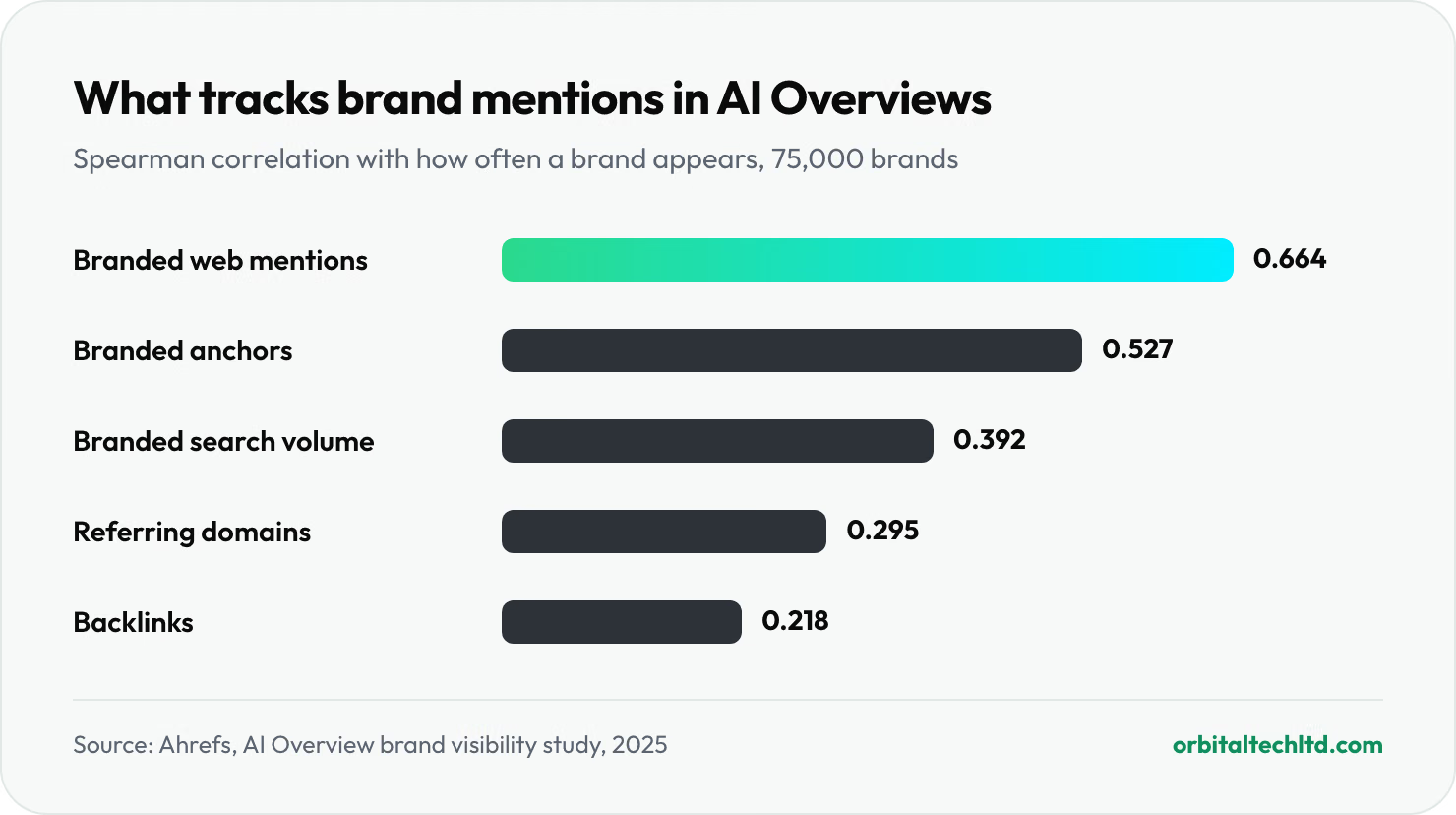
Correlation is not proof of cause, but the pattern makes sense: AI answers draw on reviews, forums, comparison articles and news, so a business that others talk about gets named. Practical ways to earn those mentions: keep review profiles active and reply to reviews, answer questions in the communities your customers use, publish original data others want to reference, and pitch expert comment to trade publications. Google also warns against "inauthentic" mention schemes, so paid placements dressed up as opinion are a risk, not a shortcut.
Step 8: Measure what AI search sends you
- Google Search Console: since June 2026, Search Console has a generative AI performance report showing how often your URLs appear in AI Overviews, AI Mode and Discover, by page, country, device and date. Google rolled it out to all sites on 31 August 2026. It shows impressions only, not clicks, so pair it with your normal performance report.
- Bing Webmaster Tools: its AI Performance report, launched in February 2026, counts how often your pages are cited in Copilot and Bing's AI summaries, and shows sample "grounding queries", the searches the AI ran before citing you.
- Your analytics: set up a channel or segment for referrals from chatgpt.com, perplexity.ai, gemini.google.com and copilot.microsoft.com, and track leads from it, not just visits.
- Spot checks: ask the tools the questions your customers ask, note who gets cited, and repeat monthly, since answers change.
AI search keyword research and gap analysis
Keyword research still works, but the questions are longer and the competition is for a mention, not a position. A simple process for a small team:
- Collect the questions. Pull long, question-style queries from Search Console, the People Also Ask boxes for your main topics, Bing's grounding queries, and the questions your sales team hears every week.
- Turn them into prompts. Write 20 to 50 prompts the way a customer would ask an assistant, such as "best accounting firm for a small online shop in Manchester" or "is a WMS worth it for 500 orders a day".
- Run a gap analysis. Ask each prompt in ChatGPT, Perplexity, Gemini and Google's AI Mode. Record which brands and pages are cited. Where competitors appear and you do not, check whether you have a page that answers that exact question, and whether third-party sites mention you for it.
- Fill the gaps in order. First the pages you are missing, then clearer answers on pages you already have, then the outside mentions.
For most small businesses, a monthly spreadsheet of 30 prompts is enough to see whether the work is moving anything.
What are the best AI search optimization tools?
The best starting tools are free, because they come from the search engines themselves. Paid trackers are worth it once you need to monitor hundreds of prompts or report to a board.
| Tool | Cost | What it tells you |
|---|---|---|
| Google Search Console | Free | Impressions in AI Overviews, AI Mode and Discover by page |
| Bing Webmaster Tools | Free | Citations in Copilot and Bing AI answers, plus grounding queries |
| Google Analytics 4 or similar | Free | Visits and leads from ChatGPT, Perplexity, Gemini and Copilot |
| Server logs or your CDN dashboard | Usually included | Whether AI crawlers are reaching your pages, or being blocked |
| Ahrefs Brand Radar, Semrush AI toolkit, Profound and similar | Paid | Brand mentions and citations across many prompts, against competitors |
People also ask which AI is best for search engine optimization work itself. General assistants such as ChatGPT, Gemini and Claude are useful for drafting outlines, grouping keywords, writing schema and summarising competitor pages. None of them replaces checking facts against primary sources, and Google's guidance warns against mass-producing pages with AI, which falls under its spam policy on scaled content.
What is the 30% rule for AI?
The "30% rule" is an informal rule of thumb, not a standard or a Google policy, and different writers define it differently. The most common version says to let AI handle around 30% of repetitive, rule-based work and keep the rest for human judgment; others flip the split. For search content the useful lesson is the same either way: AI can speed up research and drafting, but a person who knows the subject should own the facts, the examples and the final edit. Pages that read like everyone else's are exactly what AI answers skip.
What not to bother with
- Special AI files. Google says it does not use files such as
llms.txtfor Search, so they will not get you into AI Overviews. Some sites publish one for other tools; it does no harm, but there is no published evidence it earns citations. - Rewriting everything "for AI". Google lists this as unnecessary. Clear writing for people is what gets cited.
- Mass-produced AI content. Hundreds of thin pages break Google's scaled content policy and rarely make good sources anyway.
- Tools that promise a ranking. Google warns that no third-party tool can see its internal AI systems.
Is SEO dead because of AI search?
No. AI tools find their sources by searching the web, so the businesses that rank, publish clear answers and are talked about are the ones that get cited. What has changed is that simple questions are increasingly answered without a click. The response is to target questions where people want detail, comparison or a provider, and to judge the work on leads rather than raw traffic. Our comparison of SEO vs PPC shows how AI Overviews changed the economics of both channels.
Who should make AI visibility a priority?

| Your situation | Priority | Where to start |
|---|---|---|
| B2B, SaaS or professional services; buyers research and compare | High | Comparison pages, original data, mentions in trade press and review sites |
| Publishers and information sites that rely on informational clicks | High | Measure the click loss, then build pages people still need to visit: tools, data, depth |
| Ecommerce stores | Medium to high | Server-rendered product data, reviews, Merchant Center feeds, buying guides |
| Local service businesses | Medium | Google Business Profile, reviews, consistent listings, clear service and area pages |
| New sites with little traffic | Lower, for now | Fix the technical basics and earn rankings first; AI visibility follows |
If you run a small business, our guide to SEO for small business covers the groundwork in the right order.
3 tips to get cited faster
- Audit your crawler access this week. Check robots.txt, your CDN's bot settings and your logs for OAI-SearchBot, PerplexityBot and Bingbot. It takes an hour and it is the most common silent failure.
- Rewrite your top ten pages answer first. Put a two sentence answer under each heading, add a dated number with a named source, and make sure the text is in the raw HTML.
- Track 30 prompts every month. Record who gets cited for the questions your customers ask, and use the gaps to decide which page to write or which publication to pitch next.
Our verdict on AI search optimization
AI search optimization is not a replacement for SEO and not a trick. It is SEO done with more care for three things: whether AI crawlers can actually read your pages, whether each passage answers a question on its own, and whether the rest of the web vouches for your business. The traffic is still small, but it converts, and the share of searches answered by AI is only growing. Start with access and the basics, then spend most of your effort on original, clearly written answers and on being mentioned where your customers already look.
Our SEO services cover all eight steps as one program, with monthly plans from $1,200, and our guide to how much SEO costs explains what agencies, consultants and freelancers typically charge.