Short answer: most businesses pay $500 to $5,000 a month for SEO. In Ahrefs' survey of 439 SEO providers, 63% of budgets fell in that range, the average monthly retainer was $2,917, and the most common band was only $501 to $1,000 a month. Hourly work averages $111 an hour, and one-off projects most often cost $2,501 to $5,000.
So how much does SEO cost for your business in particular? It depends on who does the work, how competitive your market is and how much content and link building you need. A local plumber and a national online store both buy "SEO", but not the same amount of it. This guide breaks down SEO pricing by model, provider, business size and line item, adds the 2026 numbers most pricing guides leave out (link prices, tool subscriptions, salaries, ad costs and AI Overviews), and ends with a simple way to size your own budget.
SEO cost in 2026: the numbers that matter
Most SEO pricing articles quote ranges with no source. Here are the figures behind this guide, each linked to the page where we checked it.
| Measure | Figure | Source |
|---|---|---|
| Average monthly SEO retainer | $2,917; most common band $501 to $1,000 | Ahrefs survey of 439 providers |
| Share of budgets between $500 and $5,000 a month | 63% | Ahrefs survey of 439 providers |
| Average hourly rate | $111; 90% charge $150 or less | Ahrefs survey of 439 providers |
| Average acceptable price for one high-quality link | $508.95 | Editorial.Link survey of 518 SEOs, 2026 |
| Minimum monthly budget to compete in very competitive niches | $8,406 on average | Editorial.Link survey of 518 SEOs, 2026 |
| Median pay for market research analysts and marketing specialists in the US | $78,760 a year | US Bureau of Labor Statistics, May 2025 |
| Average Google Ads cost per click | $5.42 | WordStream, 2026 |
| Click-through rate drop for the top organic result when an AI Overview shows | 58% lower | Ahrefs, 2026 |
One caveat on the Ahrefs survey: it is the largest public study of what SEO providers charge, but it was last updated in 2024. Link prices and ad costs have risen since, so treat its averages as a floor rather than a ceiling.
SEO pricing 2026: retainer, hourly or per project
SEO pricing 2026 still follows three main models, and most providers use more than one. A common pattern is a project to fix the foundations, then a monthly retainer to keep growing.
| Pricing model | Share of providers offering it | Typical price | Best for |
|---|---|---|---|
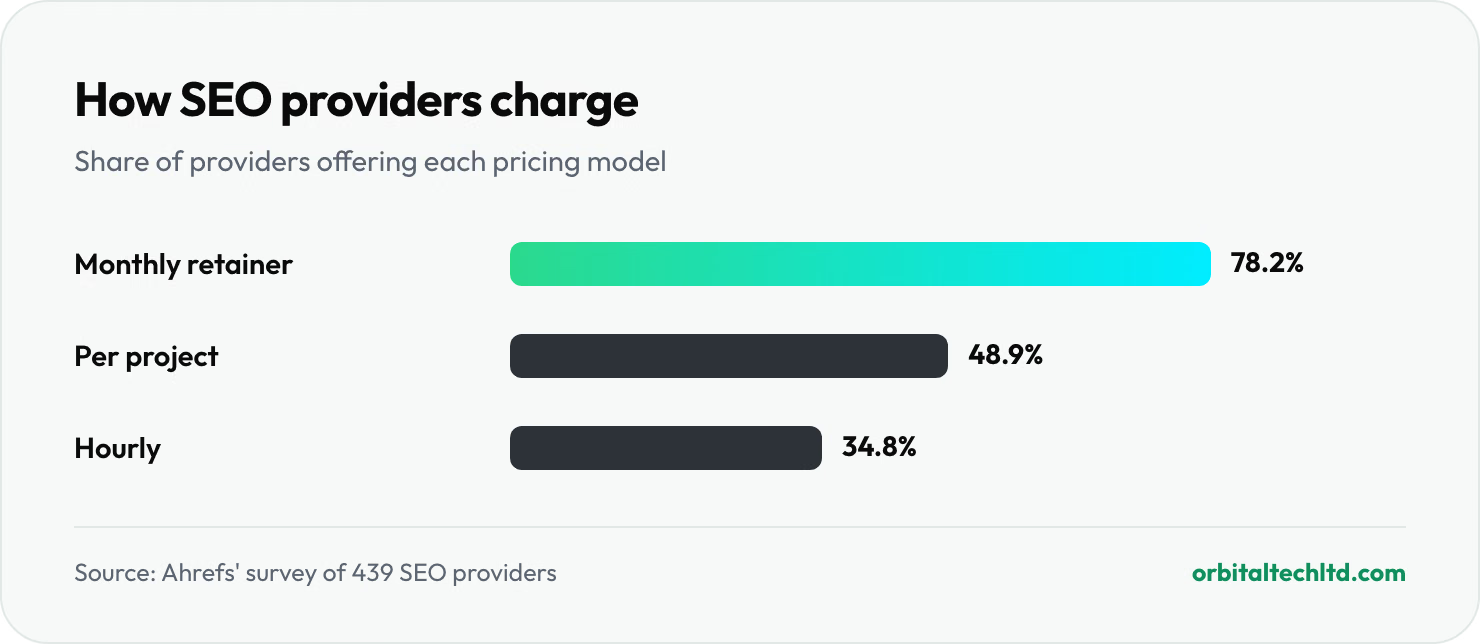
| Monthly retainer | 78.2% | $500 to $5,000 a month; average $2,917 | Ongoing content, links and technical upkeep |
| Per project | 48.9% | Most common band $2,501 to $5,000 | Audits, migrations, one-off fixes |
| Hourly | 34.8% | Average $111; most common band $75 to $100 | Consulting, training, second opinions |
Monthly retainers
Retainers suit SEO because results compound. A page published in month two is still bringing in visitors in month twelve, and a link earned this year keeps paying off. In the Ahrefs survey, 42.8% of providers charge $501 to $2,000 a month, and 31.2% charge more than $2,000.
Per project
Project fees cover work with a clear end: a technical audit, a site migration, a content plan or a penalty cleanup. 60.6% of providers charge more than $1,000 per project, and agencies most often charge $2,501 to $5,000.
Hourly consulting
Hourly rates suit advice rather than delivery: a strategy review, training for your marketing team, or a second opinion on an agency proposal. At the average of $111 an hour, a $500 monthly budget buys about four and a half hours of work, which is worth knowing when you compare cheap retainers.
Performance-based pricing
Some providers charge only for rankings or leads. It sounds safe, but it rewards the provider for picking easy keywords nobody searches for, or for short-term tactics that can get a site penalized. If you consider it, define the result in revenue or qualified leads, not rankings, and read the contract for what happens when Google updates its algorithm.
What agencies, consultants and freelancers charge
Who you hire changes the price more than almost anything else. These averages come from the same Ahrefs survey:
| Provider | Monthly retainer | Hourly rate | Per project | What you typically get |
|---|---|---|---|---|
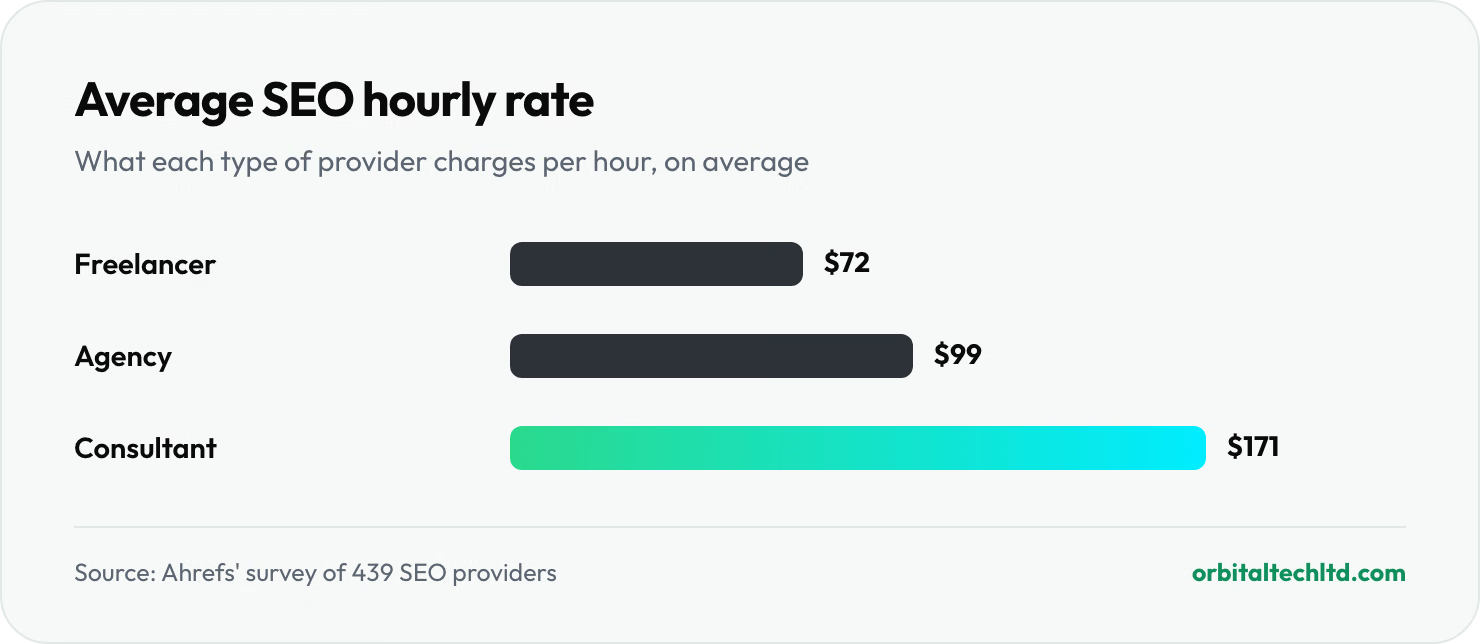
| Freelancer | $1,349 | $72 | $2,349 | One person, usually strongest in one area such as content or technical SEO |
| Agency | $3,209 | $99 | $9,508 | A team covering technical, content and links, with reporting and account management |
| Consultant | $3,250 | $171 | $8,686 | Senior strategy and direction, with your team or other vendors doing the work |
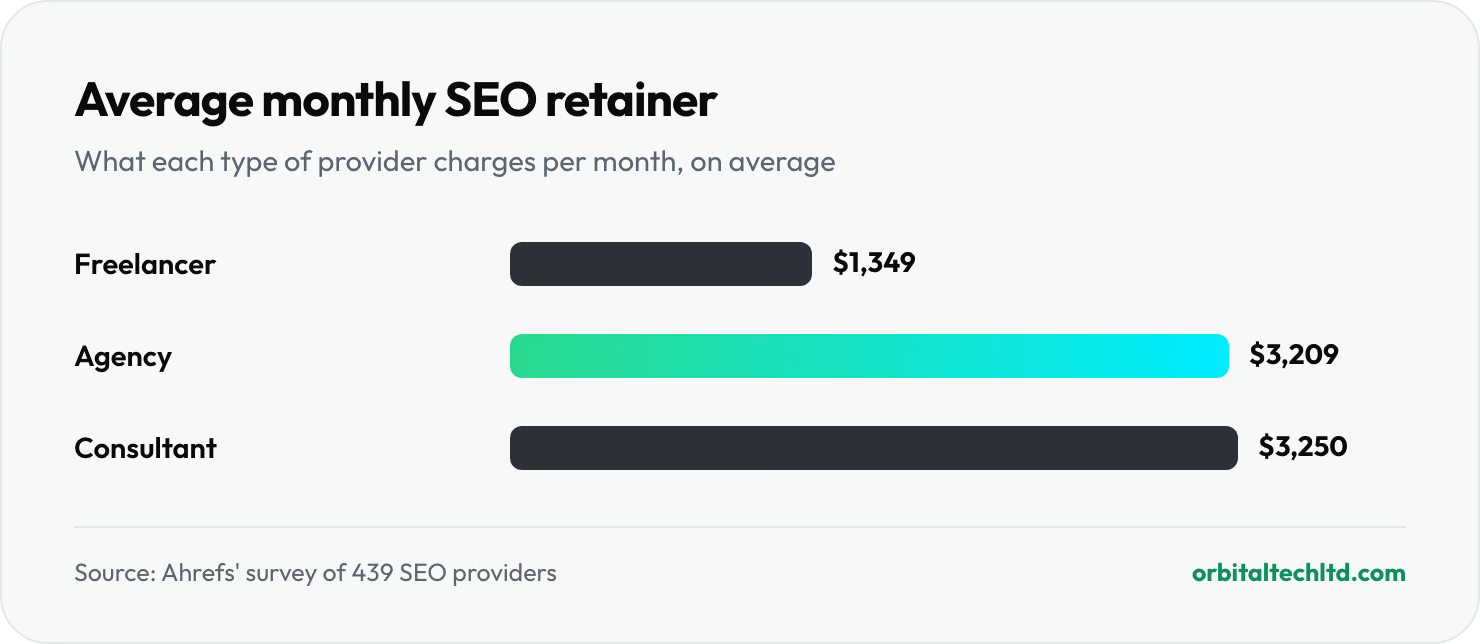
Agencies charge about 138% more per month than freelancers, but the hourly gap tells a different story. A consultant's hour costs more than twice a freelancer's, because you are paying for judgment rather than hands. An agency sits in the middle on hourly cost and on top for project fees, because several specialists work on the same site.
How much does SEO cost per month?
For most small and mid-sized businesses, the SEO cost per month is $500 to $5,000. The most common band is $501 to $1,000, while the average of $2,917 is pulled up by larger agency contracts. Where you land depends on who does the work and how much of it there is.
Use these bands to sense-check a proposal. They are a guide based on what the work takes, not survey figures.
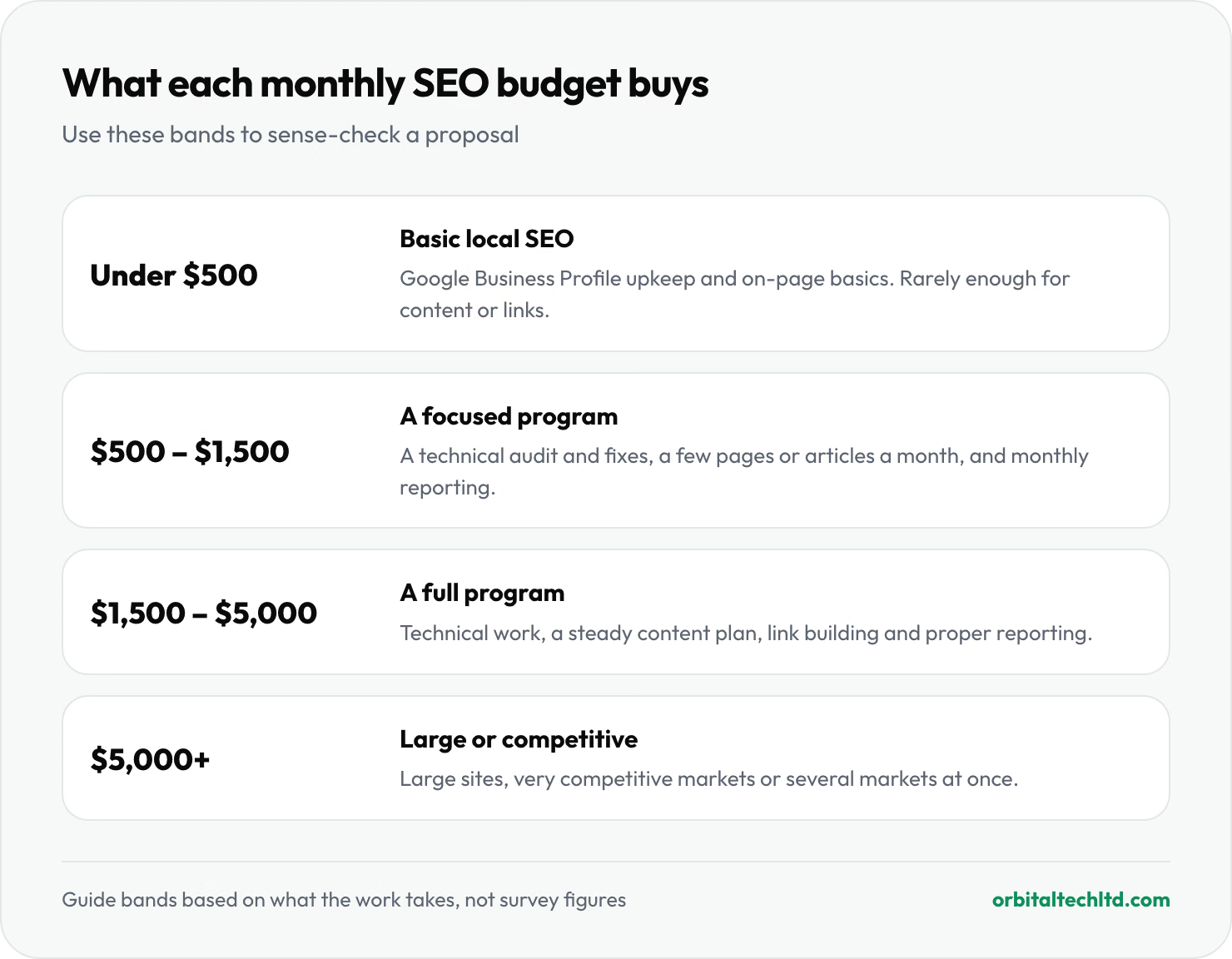
- Under $500 a month: enough for basic local SEO, such as keeping a Google Business Profile current and fixing on-page basics. Rarely enough for content or links. Be wary of anyone promising national rankings at this price.
- $500 to $1,500 a month: a focused program. Expect a technical audit and fixes, a few pages or articles a month, and monthly reporting.
- $1,500 to $5,000 a month: a full program with technical work, a steady content plan, link building and proper reporting. This is where most growing businesses competing nationally land.
- $5,000 or more a month: large sites, very competitive markets, or several markets at once. Editorial.Link's 2026 survey put the average minimum budget to compete in highly competitive niches at $8,406 a month.
SEO cost by business size
In SEO pricing 2026 data, business size matters less than the size of the job, but bigger businesses tend to have more pages, products, locations and competitors.
| Business | Typical scope | Typical monthly budget |
|---|---|---|
| Local service business, one location | Google Business Profile, service pages, reviews, local links | $500 to $1,500 |
| Small business selling regionally or nationally | Technical fixes, 2 to 4 new or refreshed pages a month, some outreach | $1,000 to $3,000 |
| Ecommerce store or SaaS company | Category, product or use-case pages, crawl fixes, content and links | $2,500 to $7,500 |
| Enterprise or multi-market site | Large-scale technical work, many content streams, digital PR, several languages | $7,500 and up |
These are planning ranges based on what each scope takes, not survey averages. For context, Ahrefs found that about 42% of providers charge $250 to $1,000 a month, the range most small local sites start in. Stores face extra technical work on filters, variants and duplicate URLs, which is why ecommerce SEO tends to sit higher than a brochure site.
How much does SEO cost for a small business?
A small business usually pays $500 to $2,000 a month for SEO done by someone else, or a few hours a week plus around $100 a month in tools if the owner does it. The right amount depends on how much each new customer is worth. A dentist who earns thousands from one patient can justify more than a café.
Start with the free foundations before paying anyone: Google Search Console, Google Business Profile and clear pages for each service you sell. Our guide to SEO for small business walks through those steps in order.
How much does local SEO cost?
Local SEO is the cheapest kind, because the competition is limited to one area. Ahrefs found providers serving only local clients average $1,557 a month, with local agencies at $1,819 and local freelancers around $1,150. Providers serving clients worldwide average $3,474, more than twice as much.
Most local SEO cost goes on four things: the Google Business Profile, reviews, consistent business listings, and location pages that earn a place in the map results. The profile itself is free, and our guide to Google Business Profile optimization covers what to fill in. When the work outgrows your time, our local SEO services handle profiles, reviews, citations and location pages.
How much does an SEO audit cost?
An SEO audit cost is usually a one-off project fee. For a small site, a basic audit often lands in the low thousands; a large store or a site migration review can cost far more, because the crawl, the analysis and the fix list all grow with the number of pages. In the Ahrefs survey, the most common project band for agencies was $2,501 to $5,000, and for consultants $5,001 to $10,000.
Two things matter more than the price. First, the output should be a fix list ranked by impact, not a 200-row export from a tool. Second, someone has to implement it. An audit only pays off when the fixes ship, so ask who does that and what it costs. You can also run the basics yourself with our technical SEO audit checklist.

What you are paying for: the six line items
Every answer to how much does SEO cost comes down to some mix of these six line items. Knowing them helps you compare proposals line by line.
| Line item | What it covers | What drives the price |
|---|---|---|
| Audit and strategy | Crawl, keyword research, competitor review, a plan | Site size and how many markets you target |
| Technical fixes | Speed, indexing, redirects, structured data | Developer time and how old or complex the site is |
| Content | New pages, refreshes, internal links | Volume, research depth and subject-matter input |
| Links and digital PR | Earning mentions and links from other sites | Niche competitiveness; $508.95 is the average acceptable price per quality link |
| Tools | Keyword, rank and crawl data | Ahrefs plans run from $29 to $449 a month; Search Console is free |
| Reporting | Traffic, leads and revenue from organic search | How deep the tracking and analysis go |
Content and links are usually the biggest items. Two well-researched articles a month and twelve are very different budgets, and earning links through digital PR is slow, skilled work. That is why a cheap retainer often skips links entirely, or buys low-quality ones in bulk.
What makes SEO cost more or less
How competitive your market is
Ranking a dentist in one town is a different job from ranking a software company for "project management tool" across the US. The more established sites you are up against, the more content and links you need, and the longer it takes.
How big and how broken your site is
A 15-page brochure site has a short technical checklist. A 20,000-product store with faceted navigation, duplicate pages and slow templates needs real engineering time before content work can pay off.
Where your provider is based
Location changes SEO prices sharply. In the Ahrefs survey, 79.1% of providers in the US and Canada charge at least $1,001 a month, while 76% of providers in India charge $1,000 or less. Lower rates are not automatically worse, but check that the team works in your language, understands your market and overlaps with your working hours.
How experienced your provider is
Providers in their first two years averaged $1,541 a month, while those with 5 to 10 years of experience averaged $3,648. Hourly rates follow the same curve, from $73 an hour for newer providers to $118 for those with more than ten years.
How AI search changes the work
The top organic result now gets 58% fewer clicks when an AI Overview appears, according to Ahrefs' 2026 update. Good SEO now has to earn citations inside AI answers as well as rankings below them. That mostly means clearer pages, structured data and mentions on other trusted sites, not a separate budget. Be wary of anyone selling AI visibility as an expensive add-on. Our guide to SEO for AI search explains what actually earns those citations.
SEO packages: how to compare them like for like
SEO packages make prices easy to compare on the surface, but two $1,500 packages can buy very different amounts of work. Before you sign, ask each provider to fill in the same short list:
- Hours or deliverables per month. How many pages written or refreshed, how many technical fixes shipped, how many outreach campaigns run.
- Who implements technical fixes. If the answer is "your developer", add that cost to the package price.
- How links are earned. Digital PR, partnerships and useful resources, or links bought by the hundred.
- What is reported. Organic traffic, leads and revenue, not just rankings.
- Contract terms. Minimum length, notice period and who owns the content and accounts.
A package that looks cheap and leaves out implementation or links is not a cheaper version of the same thing. It is a smaller job.
Agency, freelancer, consultant or in-house?
Often the honest answer to how much does SEO cost is: it depends who does the work. Each option suits a different situation.
| Option | Typical cost | Choose it when | Watch out for |
|---|---|---|---|
| Do it yourself | Your time, plus $0 to $129 a month in tools | Small site, local market, an owner willing to learn | The hours it takes away from running the business |
| Freelancer | About $1,349 a month | Narrow needs, such as content or a technical cleanup | Gaps outside their specialty; one person's availability |
| Agency | About $3,209 a month | You need technical, content and links handled together | Junior staff on your account; vague deliverables |
| Consultant | About $3,250 a month or $171 an hour | You have people to do the work and need direction | Advice that nobody has time to implement |
| In-house hire | Around $78,760 a year median pay, before benefits and tools | Search is a core channel and you have enough work for a full-time role | One person rarely covers development, content and PR |
The in-house figure uses the US Bureau of Labor Statistics median for market research analysts and marketing specialists, the occupation group that includes search marketing strategists. That works out to about $6,563 a month in salary alone, so a hire only beats an agency when there is a full-time job's worth of work.
Keyword research and gap analysis: how to size your budget
The most reliable way to set a budget is to work backwards from the searches you want to win. A keyword research and gap analysis does that in four steps:
- List the searches that bring customers. Your services, your products and the problems they solve, with monthly search volume from a tool such as Ahrefs or the free Google Ads Keyword Planner.
- See who ranks today. If the first page is full of national brands and strong publishers, you need more content and links than if it is full of small local sites.
- Find the gap. Compare your site with two or three competitors in a content gap tool. The keywords they rank for and you do not are your content plan, and its size is the biggest driver of what you will pay.
- Put a value on the traffic. Multiply the visitors you could win by what each one is worth to you.
A quick way to value step four is to look at what the same click would cost as an ad. The average Google Ads click costs $5.42 in 2026, according to WordStream. If an SEO program brings 500 extra visitors a month for keywords that average that price, it is producing about $2,700 a month in traffic you no longer need to buy. Our SEO vs PPC guide runs this comparison in detail.

Is it worth it to pay for SEO?
Usually yes, if you can wait for it and a customer is worth enough. The test is simple: work out what a visitor is worth to you, then compare the monthly fee with the traffic and leads it brings in once it is working.
Here is a worked example with illustrative numbers. Say 2% of visitors become leads and you close one lead in five, at $3,000 a customer. Each visitor is worth $12. A $1,500 monthly program pays for itself at 125 extra visitors a month, and the traffic it builds keeps arriving after the work is done, which paid ads do not. For comparison, WordStream puts the average cost per lead from search ads at $66.69 in 2026, and that cost recurs every month you advertise.
The catch is time. Technical fixes can show movement within weeks, but content and links usually take six to nine months to compound, longer in very competitive markets. If you need leads next week, paid search is the better tool, and it works well alongside SEO.
Is SEO still worth it in 2026?
Yes, but the job has changed. AI Overviews and chat assistants answer more questions on the results page, so fewer searches end in a click, and the top result loses clicks when an AI Overview appears. At the same time, those AI answers draw on pages that rank and are clearly structured. SEO in 2026 is about being the source the answer cites as well as the link people click.
Paid search is not an escape from this either. The average Google Ads click has more than doubled in a decade to $5.42. For businesses whose customers start on Google, organic search is still the channel where each extra visitor costs the least once the work is done.
Is SEO worth it for small businesses?
For most, yes, as long as the scope matches the market. A local business does not need a national content program. It needs a complete Google Business Profile, reviews, fast service and location pages, and a steady trickle of local links. That can be done for a few hundred dollars a month, or for the owner's time.
It is less worth it for a business that needs customers this month and cannot carry the cost for six months, or whose customers do not yet search for what it sells. Then ads or referrals come first.
Can I do SEO on my own?
Yes, especially the basics. If you have a small site, a few hours a week and someone willing to learn, you can set up Search Console, fix the issues it flags, write clear pages for each service, and keep your Google Business Profile current. Free tools cover most of this, and paid ones start at $29 a month for Ahrefs' Starter plan.
The hidden cost is time: ten hours a month on SEO is ten hours not spent selling. Paying for help makes sense when the work outgrows your time, such as a large or complex site, a competitive market, or a content plan that needs steady monthly output.
Red flags in cheap SEO
- Guaranteed #1 rankings. Google's own guide to hiring an SEO is blunt: "No one can guarantee a #1 ranking on Google."
- Hundreds of links for a small fixed fee. Links bought in bulk usually come from low-quality sites and can cost you rankings in a core update.
- No access to your own data. You should own your Search Console, analytics and content, and see every change made to your site.
- Reports full of vanity metrics. Rankings for terms nobody searches for are not progress. Ask for traffic, leads and revenue from organic search.
- Long lock-in contracts. A minimum term while the groundwork is done is normal. A year with no exit is not.
Google also publishes a list of questions to ask before you hire an SEO, updated in 2026: ask for examples of past work, how they follow Google's guidelines, what results to expect and over what time, and whether they will explain every change they make. It is worth working through with any provider, including us.
What SEO costs with Orbital
Our prices are published on our pricing page, so you can compare us with anyone else before we talk.
- Starter, $1,200 a month: SEO as your one service, with a dedicated project manager, weekly demos and updates, and two-week sprints.
- Growth, $3,400 a month: up to three services bundled, for example SEO with web development or paid ads, with a senior strategist and weekly strategy and reporting calls.
- Scale, $7,900 a month: unlimited services with an embedded fractional CMO or CTO, for businesses running several channels at once.
Every monthly plan has a 90-day minimum, then runs month to month. A one-off technical SEO audit can be quoted as a standalone project. Our SEO services cover technical fixes, content, links earned through digital PR and partnerships, and monthly reporting on rankings, traffic and revenue, and our own developers ship the technical fixes.
3 tips before you sign an SEO contract
- Get every quote in the same format. Ask each provider for monthly deliverables, who implements fixes and how links are earned. Without that, you are comparing prices for different jobs.
- Agree on the numbers that count. Set organic leads or revenue as the measure from day one, and make sure you own the analytics and Search Console accounts.
- Commit for long enough to judge it. Budget for at least six months. Judging SEO after six weeks usually means paying for the groundwork and leaving before the results.
Our verdict: how much should you spend on SEO?
Spend enough to do the job your market demands, and no more. For a local business, that is often $500 to $1,500 a month or the owner's time. For a business competing nationally, it is usually $1,500 to $5,000. For very competitive niches, it can pass $8,000. Whatever the figure, pay for deliverables you can see, judge results on leads and revenue, and give the work at least six months.
The real answer to how much does SEO cost is the price of winning the searches your customers make. Size that first, with a keyword gap analysis, and the budget follows.