Short answer: a working web app MVP typically costs $15,000 to $90,000 to build, a mobile or SaaS MVP $20,000 to $135,000, and testing the idea first with a landing page or clickable prototype costs $1,000 to $12,000. The range is wide because MVPs are built in hours, and the hours depend on what your first version has to prove. The tables below show the hours behind each figure, so you can check any quote against them.
MVP stands for minimum viable product: the smallest version of a product that real customers can use, and that tells you whether the idea is worth building further. It is a test, not a cut-down version of the final product. That changes how you should budget for it. If you are pricing a full product instead, our guide to how much it costs to build a web app covers portals, internal tools and complete SaaS platforms.
MVP costs by type
Not every MVP needs to be software. The cheapest way to test an idea is the one that answers your biggest question, so start from what you need to learn:
| Type of MVP | What it tests | Typical hours | At $50 an hour | At $150 an hour |
|---|---|---|---|---|
| Landing page or waitlist | Will people sign up or pre-order? | 20 to 60 | $1,000 | $9,000 |
| Clickable prototype | Do users understand it and want it? | 40 to 80 | $2,000 | $12,000 |
| No-code MVP | Will people use it, with real data? | 80 to 250 | $4,000 | $37,500 |
| Web app MVP | Will people use it and come back? | 300 to 600 | $15,000 | $90,000 |
| AI MVP | Does the AI solve the problem well enough? | 300 to 800 | $15,000 | $120,000 |
| SaaS MVP with subscription billing | Will people pay for it every month? | 400 to 800 | $20,000 | $120,000 |
| Mobile app MVP (iOS and Android, one codebase) | Will people use it on their phones? | 400 to 900 | $20,000 | $135,000 |
| Two-sided marketplace MVP | Can you attract both buyers and sellers? | 700 to 1,500 | $35,000 | $225,000 |
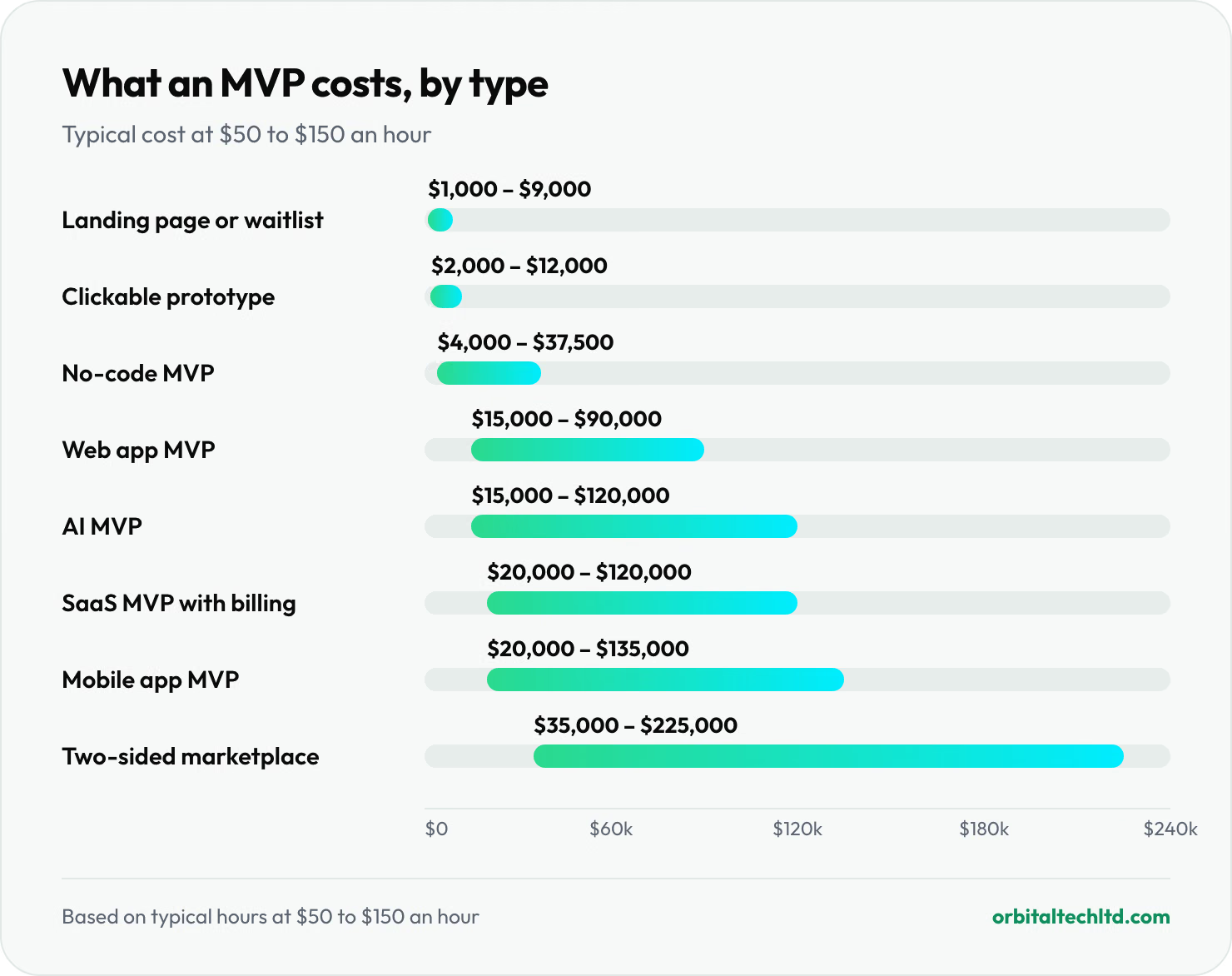
The hours are our estimates of what each type takes to design, build, test and launch. The rates are a middle range: the median wage for software developers, QA analysts and testers in the US was $64.44 an hour in May 2025, according to the US Bureau of Labor Statistics, and agencies charge more than that to cover project management, testing and overheads. Teams in lower-cost countries often charge under $50 an hour, and US agencies can charge well above $150.
A no-code MVP also carries monthly tool subscriptions. An AI MVP carries the cost of the AI model itself, usually billed per use, so its running cost grows with every conversation or document it handles.
Where the money goes in an MVP
For a typical web app MVP of 300 to 600 hours, the budget usually splits roughly like this. These are our estimates, and they shift with the project:
| Stage | Share of the budget | What it covers |
|---|---|---|
| Scoping | 5 to 10% | Deciding which features prove the idea and which wait for version two |
| Design | 10 to 20% | User flows, wireframes and the screens users will see |
| Development | 50 to 60% | The front end, back end, database, integrations and admin area |
| Testing | 10 to 15% | Checking every flow works, on the devices and browsers your users have |
| Launch and project management | About 10% | Hosting, analytics, app store submission, demos and coordination |
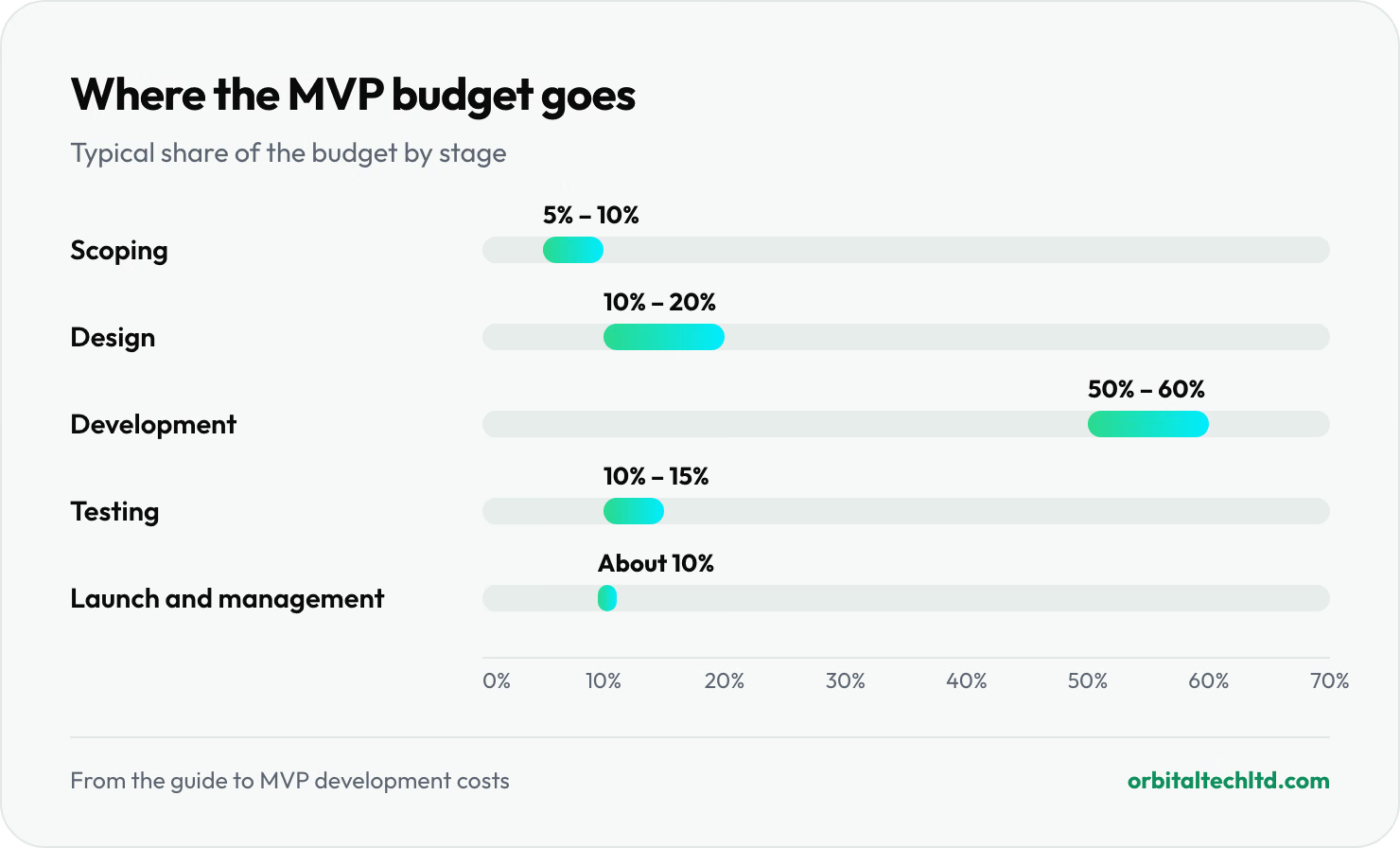
Scoping is the smallest line and the one that saves the most. Every feature cut at this stage is development, design and testing time you never pay for.
What makes an MVP cost more
Most MVP budgets grow because of a few features that look small on a list and are not small to build:
- Payments and subscriptions. Taking a one-off payment is simple. Plans, upgrades, failed payments, refunds and invoices are not.
- Two kinds of user. A marketplace or any product with, say, customers and providers is effectively two products, each with its own screens and rules.
- Integrations. Each outside system, such as a CRM, accounting software or a shipping carrier, brings its own API, limits and failure cases.
- Native mobile apps. A web app that works well on phones is often enough to test an idea. Adding iOS and Android apps adds design, testing and app store review.
- Sensitive data. Health, financial or children's data brings security reviews, audit logs and compliance work from day one.
- Polish. Animations, custom illustrations and pixel-perfect design rarely decide whether an idea works. Clear, usable design does.
How long an MVP takes
Time follows the hours. A small team of a designer and two developers puts in roughly 80 to 120 hours a week between them, so a 300 to 600 hour web MVP is about 3 to 8 weeks of build. Add scoping, your feedback after each demo, testing and launch, and most web MVPs take 2 to 4 months from first conversation to real users. Mobile and marketplace MVPs take longer, in line with their hours.
Be wary of very short promises. An MVP that ships in two weeks is usually a prototype, a no-code build or a template, which can be the right answer, as long as you know that is what you are buying.
Costs after launch
The build is not the last bill. Budget for these from the start:
- Hosting and services: servers, database, email delivery and error monitoring. A small MVP can often run on tens of dollars a month.
- Payment fees: Stripe, for example, charges 2.9% + 30¢ per successful domestic card payment, with no monthly fee.
- App store fees, for mobile MVPs: the Apple Developer Program costs $99 a year, and Google Play charges a one-time $25 registration fee. Apple's commission on in-app purchases is 15% for developers in its Small Business Program.
- AI usage: model providers charge per use, so an AI MVP's bill rises with traffic. Set a spending limit before launch.
- Iteration: the point of an MVP is to learn and change it. Keep money back for the second round of changes; it is usually the most valuable work you will pay for.
How to cut MVP cost without missing the point
- Write down the one question the MVP must answer. "Will clinics pay $200 a month to automate reminders?" is a scope. "A platform for clinics" is not.
- Test demand before building. A landing page with a waitlist or pre-order costs a fraction of a build and tells you whether anyone wants it.
- Do things by hand at first. If an admin can approve accounts, send reports or match orders manually for the first hundred customers, you don't need to build that automation yet.
- Use services instead of building them. Payments, sign-in, email and search all exist as off-the-shelf services.
- Pick one platform. Launch on the web or on one mobile platform, not everywhere at once.
- Fix the scope before the build starts. Changes are cheapest on paper. A written scope with a fixed price stops the budget drifting.
Prototype, proof of concept or MVP: which do you need?
- Prototype: a clickable design. Nothing is saved and nobody can pay. Use it to test whether users understand the idea, or to show investors. $2,000 to $12,000.
- Proof of concept: a technical experiment to check that something can be built at all, such as whether an AI model can read your documents accurately enough. Usually internal, and priced by the experiment.
- MVP: a working product that real customers can sign up for, use and pay for. Use it once you are confident in the idea and need to prove people will actually use it. $15,000 and up.
Many good products go through all three, in that order. Skipping straight to an MVP makes sense when the idea is already proven elsewhere and the question is whether you can win customers.
Questions to ask before you hire
- What exactly is in the first version, and what is not? A good quote lists both.
- Is the price fixed for that scope? If not, ask how changes are estimated and approved.
- Who owns the code and the accounts it runs on? You should, from day one.
- Will I see working software regularly? Demos every week or two are the best protection against surprises.
- Can the MVP grow into the full product? Mainstream technology means version two builds on version one instead of replacing it.
- What happens after launch? Ask what support, fixes and changes cost once real users arrive.
MVP development at Orbital
We start every MVP by cutting the scope to what tests the idea. Within 72 hours of the first week's scoping you get a written plan with the must-have features, milestones, a fixed price for that scope and a launch date. We then build in two-week sprints with a demo each time, on mainstream frameworks such as Laravel, React, Next.js and Flutter, so the MVP can grow into the full product. You own the code and the accounts it runs on.
We send a written quote within one business day of understanding what you need. See our MVP development services, or AI integration if your MVP is built around an AI feature.