Short answer: SEO earns you free clicks from Google's organic results, but takes months to build. PPC (pay-per-click advertising, such as Google Ads) buys you clicks straight away, but they stop the day you stop paying. SEO is a long-term asset; PPC is a tap you turn on and off. Most businesses that grow through search use both: PPC for immediate leads and testing, SEO for traffic that keeps compounding.
This guide compares SEO and PPC on cost, speed, durability and control, explains where SEM fits in, and shows how to split a budget between them.
What is the difference between SEO and PPC?
SEO (search engine optimization) is the work of making your pages rank in the unpaid results: fixing the technical side of the site, writing pages that answer what people search for, and earning links from other sites. You don't pay Google for these clicks.
PPC (pay-per-click) means paying to appear in the sponsored results, usually through Google Ads or Microsoft Ads. You bid on keywords, your ad shows above or below the organic results, and you pay each time someone clicks.
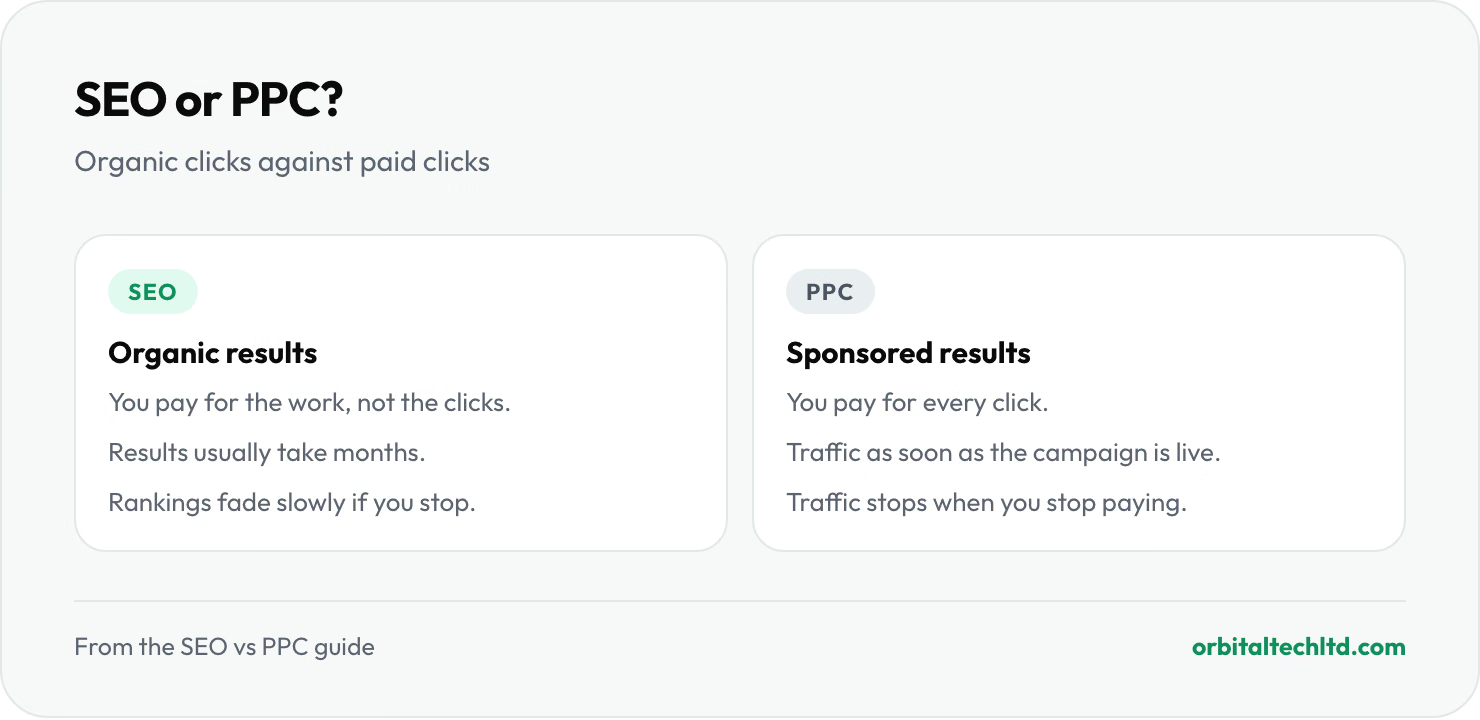
| SEO | PPC | |
|---|---|---|
| Where you appear | Organic results | Sponsored results, marked as ads |
| How you pay | For the work: content, development, links | For every click, plus management |
| Time to results | Usually months | As soon as the campaign is live |
| When you stop | Rankings fade slowly | Traffic stops straight away |
| Control | Indirect: Google decides the rankings | Direct: you choose keywords, budget, ads and pages |
| Best for | Steady traffic and authority over time | Fast leads, testing offers, seasonal pushes |
SEO vs SEM: is SEM the same as PPC?
SEM (search engine marketing) is used in two ways. Strictly, it means all marketing on search engines, both SEO and paid search. In everyday use, especially in job titles and agency menus, SEM usually means paid search ads. So "SEO vs SEM" and "SEO vs PPC" are usually the same question: free organic clicks or paid ones.
Cost: free clicks are not free
With PPC, the cost is easy to see: your monthly ad spend, plus whoever manages the account. Prices per click vary hugely by industry and keyword. Competitive commercial terms in fields like law, insurance and software can cost many times more per click than local or niche searches.
With SEO, you don't pay per click, but you pay for the work that earns the rankings: an audit and technical fixes, content, and links. That is usually a monthly retainer or a project fee. Our guide to how much SEO costs covers typical agency, consultant and freelancer prices.
The difference is in what you are left with. Ad spend buys clicks this month. SEO spend builds pages and authority that keep bringing visitors after the work is done, so the cost per visitor tends to fall over time.
Speed: PPC wins in the first months
A PPC campaign can send traffic the day it is approved, which makes it the right tool for a new business, a launch or a sale. SEO usually takes months. Technical fixes can move pages that already rank within weeks, but new content and authority usually take six to nine months to build, and longer in competitive markets.
Durability: SEO wins over time
Turn off PPC and the traffic stops. Pause SEO and rankings fade slowly, because the pages and links you built keep working. A page that ranks well can bring in visitors for years with only occasional updates.
Control and testing: PPC wins
With PPC you choose the exact keywords, the message, the landing page, the budget and even the hours your ads run, and you see results within days. That makes it an excellent testing ground: find out which offers and keywords convert with paid traffic, then invest SEO effort in the ones that proved themselves.
Trust and clicks
Many searchers skip the ads and click the first organic results, especially for research and comparison searches. Others click ads happily when they are ready to buy and the ad matches what they want. That is another reason the two work best together: ads catch people ready to act now, organic results catch the people still researching.
When to choose SEO, PPC or both
- Lean on PPC when you need leads this month, are launching something new, run a time-limited offer, or want to test which keywords convert before committing to content.
- Lean on SEO when you can wait for results, want traffic that does not depend on a monthly ad budget, or sell something people research before buying.
- Use both when search is a core channel. A common pattern is PPC-heavy in the first months, then shifting budget towards SEO as organic rankings take over the keywords ads used to cover.
How to split a budget between SEO and PPC
There is no fixed ratio, but a simple approach works for most small businesses:
- Start with what the site needs. If the site is slow or hard to crawl, fix that first: it makes both channels work better, because ads send people to the same pages.
- Run PPC on your highest-intent keywords, such as your service plus your city, to get leads while SEO builds.
- Track conversions properly, not just clicks, so you can compare cost per lead across both channels.
- Move budget towards SEO as organic rankings arrive for keywords you were paying for, and keep ads for the terms you cannot yet rank for.
For local businesses, the map results are a third option that is neither SEO on your website nor ads: our guide to Google Business Profile optimization explains how to rank there.
We run both sides. Our SEO services cover technical fixes, content and links, and our digital marketing services run paid search and social on a testing framework, reported against the same revenue numbers. If your paid budget goes to Facebook and Instagram, see our Meta ads service.