Short answer: a simple mobile app typically costs $7,500 to $45,000 to build, a first version (MVP) with accounts and a backend $20,000 to $135,000, a business app with payments and integrations $40,000 to $240,000, and a marketplace or on-demand app $75,000 to $450,000 or more. Then budget for running it: store fees, hosting, and maintenance of roughly 15 to 20% of the build cost each year. The tables below show the hours behind each figure, so you can check any quote against them.
This guide covers mobile apps for iPhone and Android. If your product runs in a web browser instead, our guide to how much it costs to build a web app is the better fit, and if you are testing a new idea, start with MVP development costs.
App development cost by type of app
App development is paid for in hours. The rates below are a middle range: the median wage for software developers, QA analysts and testers in the US was $64.44 an hour in May 2025, according to the US Bureau of Labor Statistics, and agencies charge more than that to cover project management, testing and overheads. Teams in lower-cost countries often charge under $50 an hour, and US agencies can charge well above $150.
The hours are our estimates for an app built once for both iPhone and Android with a cross-platform framework, including design, the backend, testing and store launch:
| Type of app | Example | Typical hours | At $50 an hour | At $150 an hour |
|---|---|---|---|---|
| Simple app | A few screens, no user accounts: a calculator, catalogue or event guide | 150 to 300 | $7,500 | $45,000 |
| MVP app | Sign-up, the core feature, a basic backend and admin area | 400 to 900 | $20,000 | $135,000 |
| Business app with integrations | Bookings, payments, notifications and links to your other systems | 800 to 1,600 | $40,000 | $240,000 |
| Marketplace or on-demand app | Separate apps for customers and providers, maps, live updates, payouts | 1,500 to 3,000 | $75,000 | $450,000 |
| Complex or regulated app | Health or financial data, offline sync, heavy security | 2,000+ | $100,000+ | $300,000+ |
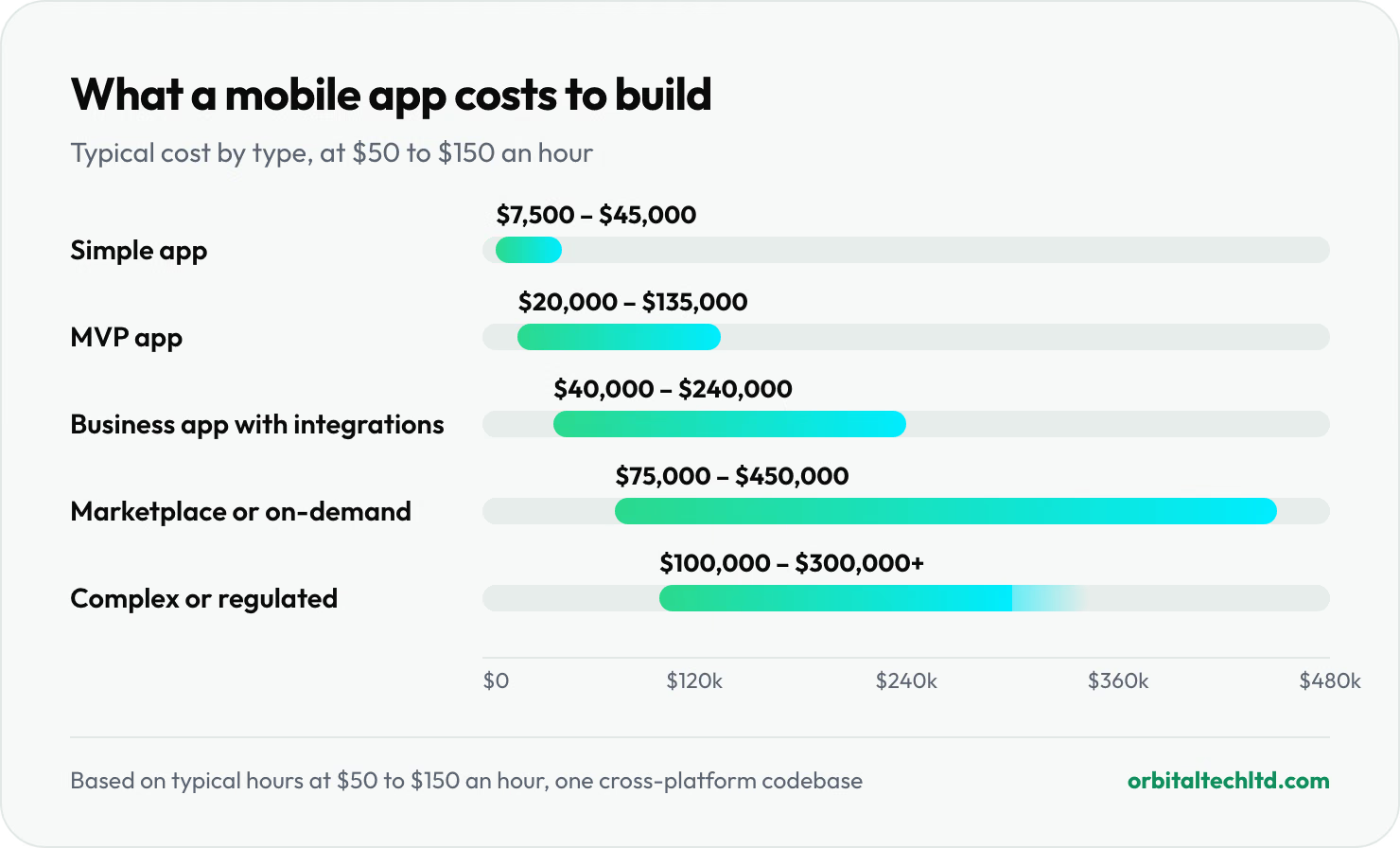
Most of the range inside each row comes from scope, not the hourly rate. Two apps described the same way can differ by hundreds of hours once the details are written down, which is why a written scope matters more than a headline price.
What drives the cost of an app
| Factor | Why it adds cost |
|---|---|
| Number of screens and user types | Every screen needs design, building and testing, and each type of user (customer, provider, admin) multiplies them |
| The backend | Accounts, data, notifications and an admin panel live on a server, and often take as much work as the app itself |
| Payments and subscriptions | In-app purchases, refunds, failed payments and store rules all need handling |
| Integrations | Each outside system, such as a CRM, booking tool or map service, brings its own API and failure cases |
| Real-time and location features | Live tracking, chat and maps need extra infrastructure and testing on real devices |
| Offline use | Saving data on the phone and syncing it later without conflicts is one of the harder problems in app development |
| Device and hardware features | Camera, Bluetooth, health data and payments hardware each need testing across many phones |
| Design depth | A clean, standard interface costs far less than custom animation and illustration |
iPhone, Android or both?
You have three ways to cover both platforms, and the choice changes the budget more than almost anything else:
- One cross-platform app. Frameworks such as Flutter and React Native build iPhone and Android apps from one codebase. This is how most business apps are built today, and it is what the table above assumes.
- Two native apps. Separate Swift and Kotlin apps give the closest fit to each platform, at the cost of building and maintaining the app twice. Our rough estimate is 1.5 to 2 times the app's share of the budget; the backend is shared either way.
- One platform first. Launching on iPhone or Android alone, based on where your customers are, can cut the first budget and delay the second platform until the idea is proven.
Native development is worth it when the app depends on the newest platform features, very heavy graphics or deep hardware access. For most business apps, one cross-platform codebase is the better use of the budget.
How long it takes to build an app
Time follows the hours. A small team of a designer and two developers puts in roughly 80 to 120 hours a week between them, so a 400 to 900 hour MVP app is about 4 to 10 weeks of build. Add scoping, your feedback after each demo, testing on real devices and app store submission, and most first versions take 3 to 5 months from first conversation to the stores. A business app with integrations usually takes 4 to 7 months. Treat these as ranges to test a quote against, not promises.
What an app costs to run
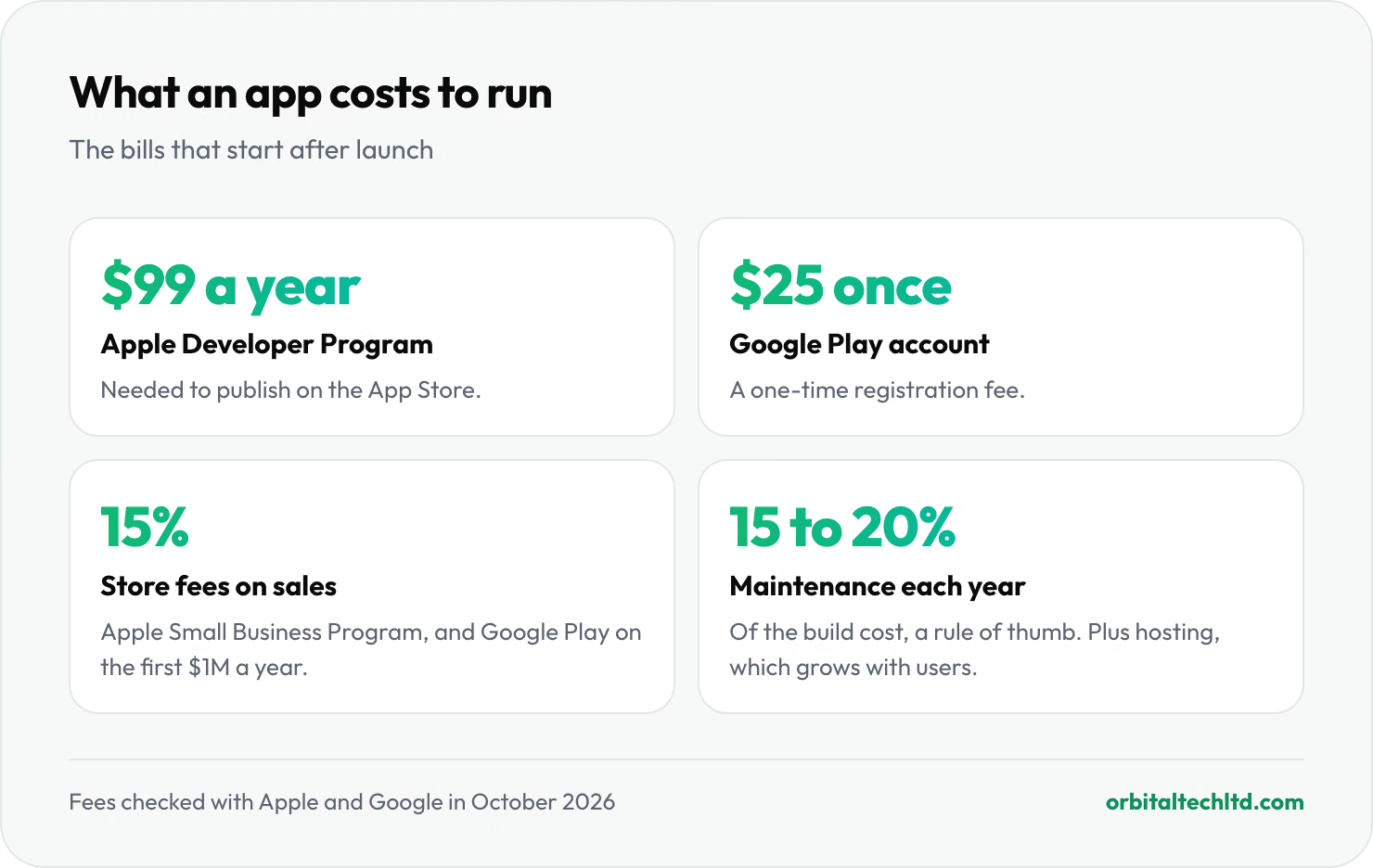
Launch is not the last bill. Budget for these from the start:
| Cost | What to expect |
|---|---|
| Apple Developer Program | $99 a year, needed to publish on the App Store |
| Google Play developer account | A one-time $25 registration fee |
| Store fees on sales | 15% on in-app purchases for developers in Apple's Small Business Program, and a 15% Google Play service fee on a developer's first $1M of earnings each year |
| Hosting and services | Servers, database, push notifications, email and error monitoring. A small app can run on tens of dollars a month; costs grow with users |
| Maintenance | Bug fixes, security updates and keeping up with new iOS and Android versions. A common rule of thumb is 15 to 20% of the build cost each year |
Maintenance is not optional. Apple and Google release a major new operating system every year, and Google Play sets a minimum Android version that apps must target: since 31 August 2026, new apps and app updates must target Android 16, and existing apps must target at least Android 15 to stay available to new users on newer Android versions, according to Google's target API requirements. An app nobody updates eventually can't be updated or found.
How to keep the cost down
- Start with the smallest version that proves the idea. One core feature done well beats ten done badly. Our guide to MVP development costs breaks this down further.
- Ask whether it needs to be an app at all. A web app that works well on phones is cheaper to build and update, and needs no store review. Build a mobile app when people will use it often, need notifications, or need the camera or location.
- Build once for both platforms. A cross-platform framework avoids paying for the same app twice.
- Use services instead of building them. Sign-in, payments, push notifications, maps and analytics all exist as off-the-shelf services.
- Agree a written scope before building. Changes are cheapest on paper. A scope with milestones and a fixed price stops the budget drifting.
How app development is priced
- Fixed price for an agreed scope. You know the cost upfront. It works best when the scope is well defined, and changes are priced separately.
- Time and materials. You pay for hours worked. Flexible when requirements are still changing, but you carry more of the budget risk.
- A dedicated team each month. A fixed monthly cost for a team that keeps building. Suits apps that will be developed continuously after launch.
Questions to ask before you hire
- Does the quote include the backend and admin panel? Some quotes cover only the screens.
- Is it one codebase or two? Ask what the price would be for the other approach.
- Who owns the code, the store accounts and the server? You should, from day one, including the Apple and Google developer accounts.
- Who handles app store submission and review? Rejections happen, and someone has to fix and resubmit.
- What does support cost after launch? Ask how yearly iOS and Android updates are handled and billed.
Mobile app development at Orbital
We build iPhone and Android apps from one Flutter or React Native codebase, with the backend and admin panel to run them. Every project starts with a week of discovery, and within 72 hours of that you get a written plan with the scope, milestones and a costed estimate you can hold us to. We then build in two-week sprints with a demo each time. You own the code and the accounts it runs on, including the store listings.
We send a written quote within one business day of understanding what you need. See our mobile app development services, or MVP development if you are testing a new idea first.