Short answer: choose Shopify if you want a store that runs itself technically, with hosting, security, checkout and updates handled for one monthly fee, and you are happy to work inside Shopify's rules. Choose WooCommerce if you already run WordPress, want full control over the code and data, or need a store that behaves in ways Shopify does not allow. Shopify is quicker and simpler to run. WooCommerce is more flexible, but you own the upkeep.
This guide compares the two on cost, ease of use, features, SEO, scaling and ownership, with the questions that decide the choice for most stores.
Shopify vs WooCommerce at a glance
| Shopify | WooCommerce | |
|---|---|---|
| What it is | A hosted ecommerce platform | A free plugin that turns WordPress into a store |
| Hosting, security and updates | Included and handled by Shopify | Your host, and you (or your developer) keep it updated |
| Monthly cost | A plan, from $19 to $299 billed yearly, plus apps | Hosting, plus any paid extensions |
| Payment fees | Card fees, plus an extra fee if you don't use Shopify Payments | Only your payment provider's fees |
| Setup | Fast: pick a theme and add products | Slower: hosting, WordPress, theme and plugins |
| Customisation | Themes, apps and Shopify's APIs, within its rules | Anything, through plugins or custom code |
| Content and blogging | Basic blog | Full WordPress publishing |
| Best for | Stores that want to focus on selling, not running software | WordPress sites, content-led brands and unusual store logic |
Cost
Shopify is a subscription. As of October 2026, its plans are Basic at $19 a month billed yearly ($25 monthly), Grow at $49 ($65 monthly) and Advanced at $299 ($399 monthly), with Shopify Plus from $2,300 a month. Card processing fees are on top, and Shopify adds a transaction fee if you use a payment provider other than Shopify Payments, at a rate that depends on your plan. Check current Shopify pricing before you budget.
WooCommerce itself is free. According to WooCommerce's pricing page, most stores pay roughly $25 to $350 a month for hosting, depending on traffic, plus optional extensions at about $29 to $299 each per year. There is no platform transaction fee; you pay only your payment provider's processing fees.
| Cost | Shopify | WooCommerce |
|---|---|---|
| Platform | $19 to $299 a month billed yearly; Plus from $2,300 | Free |
| Hosting | Included | About $25 to $350 a month |
| Apps or extensions | Many charge monthly | About $29 to $299 each per year, for paid ones |
| Payments | Card fees, plus a fee for third-party providers | Your provider's fees only |
| Maintenance | Handled by Shopify | Updates, backups and security: your time or a plan |
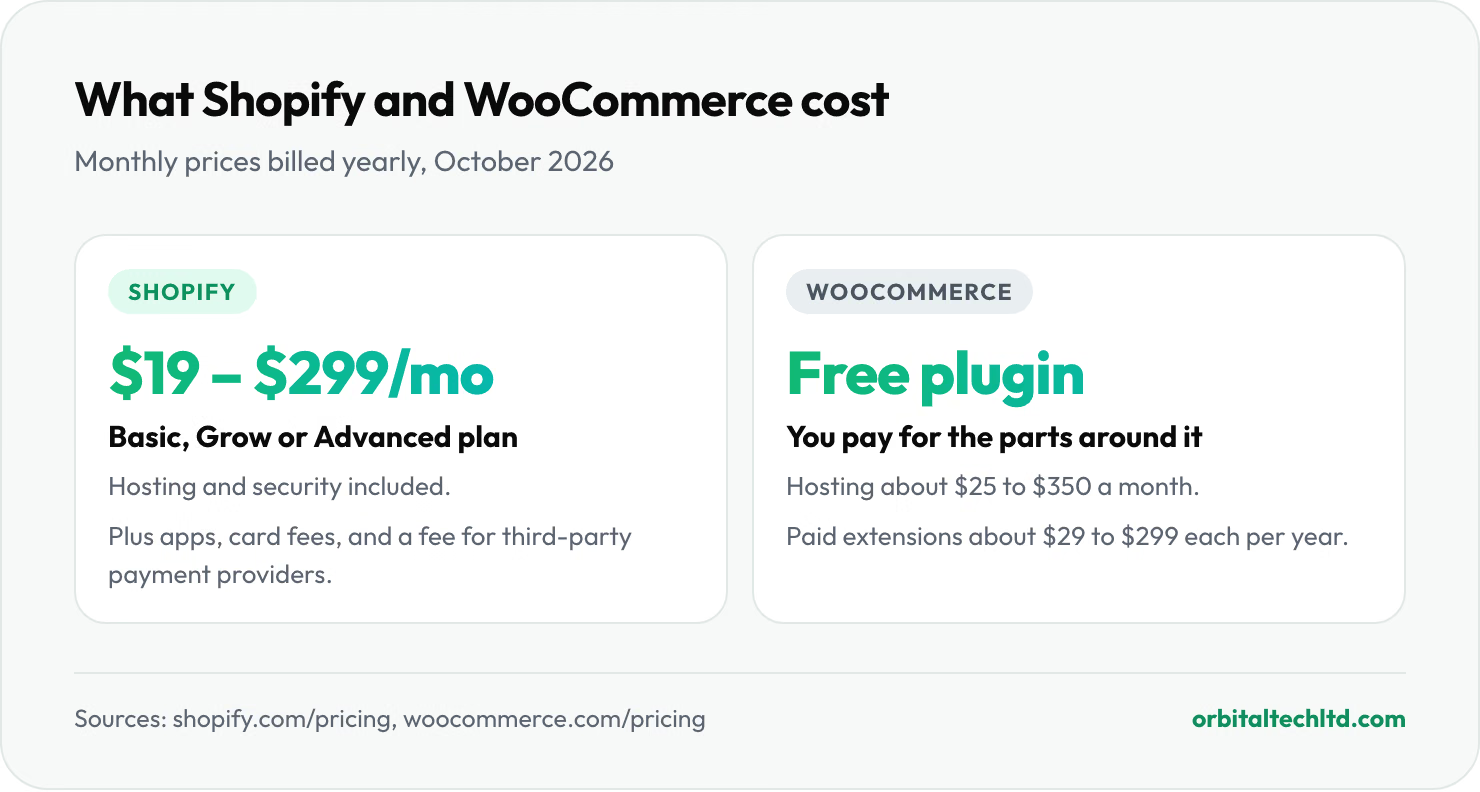
In practice the totals are often closer than the headline prices suggest. A WooCommerce store saves the subscription but pays for good hosting and someone to keep it updated. A Shopify store saves the maintenance but pays monthly for several apps. Price both with your real product count, apps and order volume.
Ease of use
Shopify is easier to start and to run. You pick a theme, add products, connect payments and launch, and Shopify handles uptime, security patches and the checkout. Staff can manage orders, stock and discounts without touching anything technical.
WooCommerce feels familiar if your team already uses WordPress. But someone has to look after hosting, WordPress and plugin updates, backups and security, and test that an update has not broken the checkout. That is fine with a developer or maintenance plan behind you, and a burden without one.
Features and customisation
Shopify covers what most stores need out of the box, and its App Store fills most gaps: reviews, subscriptions, bundles, loyalty and more. The limits show up at the edges, such as unusual checkout logic or product options beyond what Shopify supports, where you work around the platform instead of changing it. Shopify Plus loosens some of those limits.
WooCommerce is open source, so a developer can change anything: product types, pricing rules, the checkout, how orders reach your other systems. That freedom is the main reason to choose it. The cost is that every customisation is yours to maintain.
SEO and content
Both can rank well. Shopify handles the essentials, such as editable titles, sitemaps and canonical tags, but it fixes some URL patterns (products live under /products/, collections under /collections/) and can create duplicate product URLs that need managing. Our Shopify SEO services page covers those quirks.
WooCommerce runs on WordPress, which is a stronger publishing platform. If your strategy leans on buying guides, recipes, tutorials or other content to bring shoppers in, WordPress gives you more control over URLs, templates and structured data. For either platform, our guide to ecommerce SEO services explains what moves category and product pages up.
Scaling and performance
Shopify scales without you thinking about it: traffic spikes on launch days or Black Friday are Shopify's problem, not yours. WooCommerce can handle large stores too, but performance depends on your hosting, caching and how well the site is built, so growth means upgrading hosting and tuning the setup.
Ownership and lock-in
On Shopify you can export products, customers and orders, but your theme and app setup stay on Shopify. On WooCommerce you own the code and the database outright, and you can move host or developer whenever you like. Neither is a trap, but moving off Shopify is a rebuild, while moving a WooCommerce store is a migration.
Which should you choose?
Choose Shopify if:
- You want to spend your time on products and marketing, not on software.
- You don't have a developer or maintenance plan, and don't want one.
- You expect big traffic spikes and want them handled for you.
Choose WooCommerce if:
- You already run WordPress and want the store in the same site.
- Content is a big part of how you sell.
- You need store logic Shopify does not allow, or want full ownership of the code and data.
Still deciding between website platforms more broadly? Our comparison of Wix vs WordPress covers the non-store side, and our guide to how much a website costs includes what an ecommerce site costs to build and run.
We build on both. Our Shopify development services cover custom themes, integrations and migrations to Shopify, and our WordPress development team builds and speeds up WooCommerce stores. When orders outgrow your warehouse, Spiffy connects to both.