
Short answer: staff augmentation means adding skilled people from an outside company to your own team for as long as you need them. They work under your direction, in your tools and on your priorities, while the provider employs them, pays them and handles their HR. It is a way to add capacity, often developers, without hiring permanent staff. You keep control of the work; the provider takes care of the employment.
This guide explains how staff augmentation works, how it differs from project outsourcing and managed services, what it costs compared with hiring, and when it is the right choice.
How staff augmentation works
- You define the gap: the skills, seniority and number of people you need, and for how long.
- The provider proposes people who match, and you review them before they start.
- They join your team: your repository, ticketing tool, chat and stand-ups, working to your processes and priorities.
- The provider stays the employer: it handles salary, benefits, equipment, holidays and replacing anyone who leaves.
- You pay a monthly or hourly rate per person, and scale the team up or down as the work changes.
Staff augmentation vs project outsourcing vs managed services
| Staff augmentation | Project outsourcing | Managed services | |
|---|---|---|---|
| Who directs the work | You | The provider, against an agreed scope | The provider, against agreed service levels |
| What you buy | People's time | A finished deliverable | An ongoing outcome, such as support or uptime |
| Who carries delivery risk | Mostly you | Mostly the provider | The provider |
| Best when | You have a team and process, and need more hands or a missing skill | The scope is clear and you want it delivered | The work is continuous and well understood |
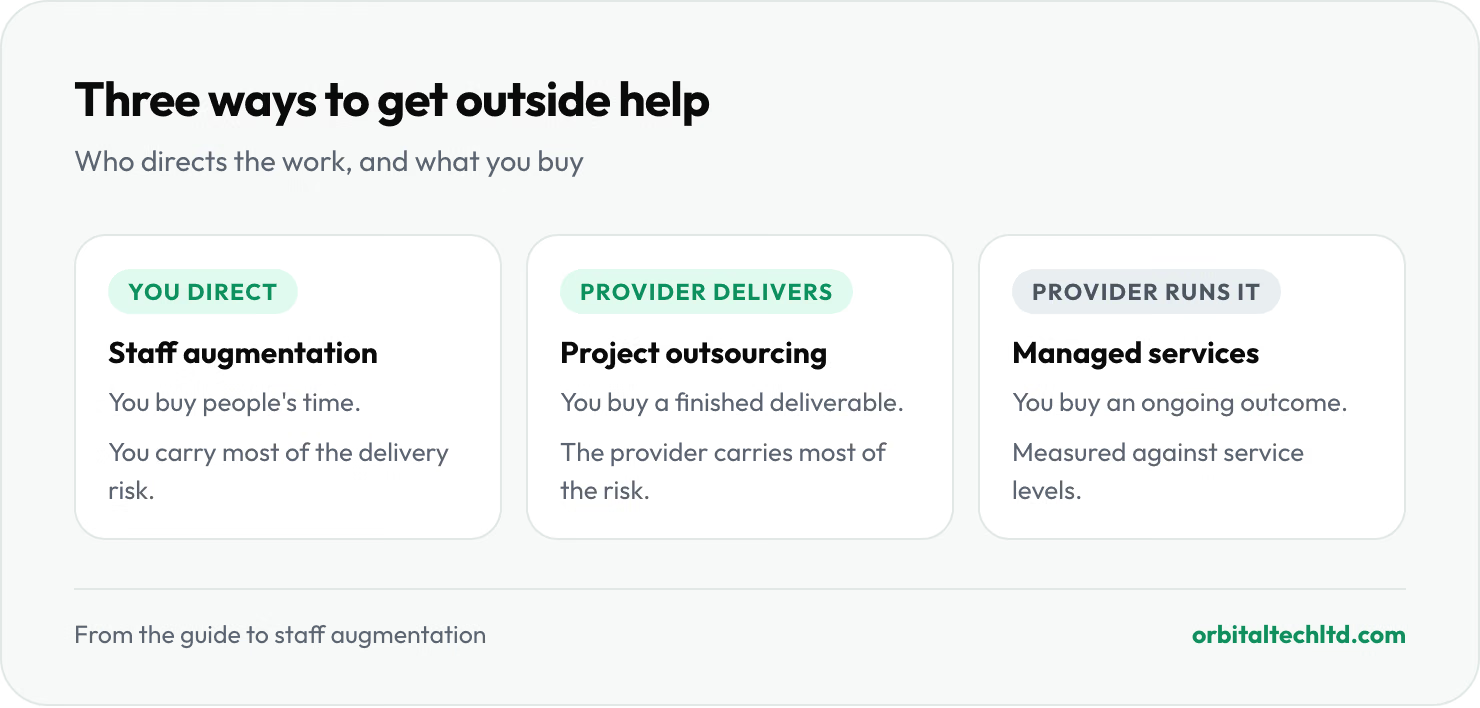
The core difference is control. With staff augmentation you manage the people and own the result. With project outsourcing you hand over a defined job and the provider manages its own team to deliver it.
When staff augmentation makes sense
- You have a product team and process already, and need to move faster than hiring allows.
- You need a skill you lack, such as a mobile developer or an AI specialist, for a few months rather than forever.
- Your workload rises and falls, and you would rather scale a team than hire and let go.
- Hiring locally is slow or expensive for the roles you need.
It is usually the wrong choice when you have no one in-house to direct the work. Augmented staff need clear priorities and someone to answer their questions. If you want a product built without managing it, project outsourcing is the better model.
What staff augmentation costs compared with hiring
An in-house hire costs more than the salary. In June 2026, benefits made up 30% of private employers' total compensation costs, according to the BLS, covering items such as health insurance, paid leave, retirement contributions and payroll taxes. On top of that come recruiting time, equipment, training, and the cost of covering for people who are away or leave.
For a sense of scale, the median wage for software developers, QA analysts and testers in the US was $64.44 an hour in May 2025, according to the US Bureau of Labor Statistics. Augmented staff are priced as a single rate that includes the provider's employment costs and margin, so compare that rate with the full cost of an employee rather than the salary alone. Teams in lower-cost countries can cost a fraction of US rates, which is why staff augmentation is often offshore or nearshore.
Benefits and risks
| Benefits | Risks to manage |
|---|---|
| Add people in weeks rather than months | Augmented staff still need onboarding and management time |
| Scale the team up or down with the work | Knowledge can leave with them, unless it is documented |
| Fill skill gaps without a permanent hire | Time-zone differences need agreed overlap hours |
| The provider handles employment and replacement | Quality depends heavily on the provider's vetting |
How to choose a staff augmentation partner
- Can you review people before they start? You should see profiles and be able to talk to candidates.
- Who owns the work? The code and everything they produce should belong to you, with an NDA in place before you share details.
- How do overlap hours work? Agree which hours they are available for meetings and questions.
- What happens if someone leaves or is not a fit? Ask how quickly they are replaced and how the handover works.
- What are the notice terms? You should be able to scale down without long lock-ins.
- Is there more than individuals? A provider that can add a project manager, designer or QA when needed is easier to grow with.
Staff augmentation at Orbital
Our headquarters is in Florida and our delivery team is in Pakistan, with overlap hours arranged around your working day. A dedicated Orbital team works in your repository, tickets and stand-ups, billed monthly, and can include engineers, a designer and a project manager. You own the code and the accounts it runs on. See our offshore software development services, or hire a dedicated Laravel team.